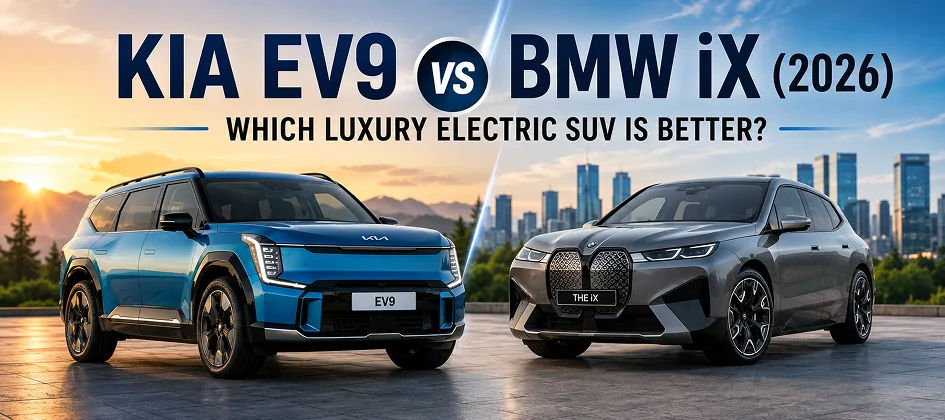
The flagship luxury electric SUV segment in India has reached a major turning point. High-net-worth buyers and EV enthusiasts in major metropolitan hubs like Mumbai, Delhi NCR, Bengaluru, Hyderabad, and Chennai no longer have to choose between long-distance touring capability, high-performance battery engineering, and multi-row executive comfort. Two models dominate this space: the Kia EV9 and the BMW iX.
When asking, "Which is better, Kia EV9 or BMW iX?", the answer depends on your primary seating requirements, driving preferences, and intended usage:
Choose the Kia EV9 if you need a full-sized, 3-row, 6-seater luxury SUV designed with adult-friendly rear passenger space, ultra-fast 800V charging, and practical utility for large families.
Choose the BMW iX if you prefer dynamic performance, bespoke 5-seater luxury craftsmanship, high power output, and the brand prestige of an established German luxury brand.
Both vehicles hover in the INR 1.30 crore to INR 1.40 crore price bracket, making a detailed head-to-head comparison essential for prospective buyers navigating the flagship luxury electric SUV India market.
This comparison pits the exact flagship variants officially sold in India against each other: the Kia EV9 GT-Line AWD and the BMW iX xDrive50.
| Specification | Kia EV9 GT-Line AWD | BMW iX xDrive50 |
| Price in India (Ex-Showroom) | INR 1.30 Crore | INR 1.40 Crore |
| Battery Capacity | 99.8 kWh | 111.5 kWh |
| Claimed Range | 561 km (ARAI) | 575 km (ARAI/MIDC) / 635 km (WLTP) |
| Real-World Range (Est.) | 380 km – 440 km | 450 km – 520 km |
| Power Output | 379 bhp (384 PS / 283 kW) | 516 bhp (523 PS) |
| Torque Output | 700 Nm | 765 Nm |
| Drive System | Dual-Motor All-Wheel Drive (AWD) | Dual-Motor All-Wheel Drive (AWD) |
| Top Speed | 200 km/h | 200 km/h |
| 0–100 km/h Acceleration | 5.3 seconds | 4.6 seconds |
| Charging Support | 350 kW DC Fast Charging (800V) | 195 kW DC Fast Charging (400V) |
| Charging Time (10–80% DC) | 24 minutes (350 kW DC) | 35 minutes (195 kW DC) |
| Seating Capacity | 6 Seats (3 Rows with 2nd-row Captain Chairs) | 5 Seats (2 Rows) |
| Boot Space | 333 Litres (All seats up) / 828 Litres (3rd row down) | 500 Litres |
| Key Features | Trinity display, massage captain's chairs, V2L, 800V architecture | Curved Display, Bowers & Wilkins audio, Sky Lounge roof, Crystal controls |
The Kia EV9 is Kia's flagship electric SUV built on Hyundai Motor Group’s dedicated E-GMP (Electric Global Modular Platform). It introduces a bold, boxy aesthetic that gives it a distinct appearance on Indian roads.
Exterior Design: Features Kia's "Digital Tiger Face", vertical stacked LED headlights, flush door handles, and 20-inch aero-optimised alloy wheels.
Battery & Range: Fitted with a 99.8 kWh battery pack providing an ARAI-certified range of 561 km on a single charge.
Performance & Charging: Powered by a dual-motor AWD setup delivering 379 bhp and 700 Nm of torque. Its 800V architecture allows 10% to 80% DC fast charging in just 24 minutes using a 350 kW fast charger.
Interior & Seating: The flagship GT-Line variant comes in a 6-seater configuration featuring second-row relaxation captain seats with power leg rests, heating, ventilation, and massage functions.
Technology & Safety: Equipped with a Trinity display setup (dual 12.3-inch screens plus a 5.3-inch climate control segment), 14-speaker Meridian audio, Vehicle-to-Load (V2L) functional power export, 10 airbags, and a Level-2 ADAS suite.
Target Buyer: Suited for large luxury families, corporate leaders needing chauffeur-driven comfort, and buyers looking for 3-row passenger space in an electric setup.
The BMW iX is the Bavarian manufacturer's purpose-built luxury electric SAV (Sports Activity Vehicle). Constructed using an aluminium spaceframe and carbon cage structural core, it combines high-performance driving dynamics with a lounge-like interior setup.
Exterior Design: Highlights an intelligent panel kidney grille with self-healing polyurethane coating, slim headlights, and frameless door glass.
Battery & Range: Features a 111.5 kWh battery pack that yields an ARAI/MIDC rating of 575 km and a WLTP rating of 635 km.
Performance & Charging: Generates 516 bhp and 765 Nm of torque via dual electric motors, accelerating from 0 to 100 km/h in 4.6 seconds. It accepts up to 195 kW DC fast charging, replenishing 10% to 80% in 35 minutes.
Interior & Comfort: Houses a 5-seater cabin featuring natural leather optioning, clear crystal glass controls for seat adjustments and iDrive, and a fixed panoramic glass roof with electrochromic shading.
Technology & Safety: Uses the BMW Curved Display running Operating System 8.5, optional Bowers & Wilkins sound with seat-integrated shakers, a 5-star Euro NCAP rating, and an active safety suite.
Target Buyer: Geared toward performance enthusiasts, boutique luxury buyers, and owners seeking German brand heritage alongside a focused 5-seater layout.
Evaluating pricing requires looking at both ex-showroom figures and actual on-road costs across different Indian states.
Ex-Showroom Pricing: The Kia EV9 GT-Line AWD is priced at INR 1.30 Crore (ex-showroom). The BMW iX xDrive50 is priced at INR 1.40 crore (ex-showroom).
On-Road Pricing Variations: On-road prices for the Kia EV9 range between INR 1.37 Crore and INR 1.39 Crore depending on state road tax policies and registration fees (such as in Mumbai or Delhi NCR). The BMW iX xDrive50 ranges between INR 1.47 Crore and INR 1.62 Crore on-road, with states like Karnataka applying higher EV registration tariffs.
Equipment Value: The Kia EV9 is sold in a single GT-Line trim with almost all features included as standard. The BMW iX is imported as a CBU (Completely Built-Up) model, where optional styling packages, custom leather, or sound upgrades can broaden the final price gap.
Overall, the Kia EV9 provides lower acquisition costs for buyers seeking max multi-row space, while the BMW iX requires a higher investment for its added power and brand positioning.
Battery size and driving efficiency directly impact daily utility and highway travel across India.
Battery Capacities: The BMW iX battery has a capacity of 111.5 kWh, whereas the Kia EV9 battery comes in at 99.8 kWh.
Official vs Real-World Range: While the official Kia EV9 range stands at 561 km (ARAI) and the BMW iX range is certified up to 575 km (ARAI) / 635 km (WLTP), real-world highway driving yields different figures. At highway cruising speeds of 100–110 km/h with active air conditioning, expected real-world range figures are:
Kia EV9 GT-Line: 380 km to 440 km
BMW iX xDrive50: 450 km to 520 km
Cruising Speeds: Sustained speeds above 100 km/h increase aerodynamic drag on both large SUVs, raising energy consumption.
Temperature & Air Conditioning: Hot weather across Indian summer months requires higher battery draw to cool multi-row cabins.
Payload & Passengers: Carrying 6 adults with luggage in the EV9 demands more battery energy than carrying 2 to 4 passengers in the iX.
Wheel Sizes: Larger wheel configurations increase rolling resistance slightly compared to standard aero-rims.
For detailed information regarding public charging networks and road-trip planning, explore our dedicated section on EV charging infrastructure in India.
The BMW iX xDrive50 is faster and more powerful than the Kia EV9 GT-Line.
Power & Torque Output: The BMW iX xDrive50 produces 516 bhp (523 PS) and 765 Nm of torque, compared to the Kia EV9's 379 bhp and 700 Nm of torque.
Acceleration & Top Speed: The BMW iX launches from 0 to 100 km/h in 4.6 seconds, while the Kia EV9 completes the same sprint in 5.3 seconds. Both luxury electric SUVs have an electronically limited top speed of 200 km/h.
Handling & Driving Characteristics: The BMW iX uses adaptive air suspension and a stiffer Carbon Cage framework to maintain body control through tight turns. The Kia EV9's suspension is tuned primarily for highway stability, vibration isolation, and passenger comfort over uneven tarmac.
Charging convenience depends on both home installation setups and public fast-charging capabilities.
DC Fast Charging Rates: The Kia EV9 utilises an 800V electrical architecture, allowing it to accept up to 350 kW of DC fast charging. The BMW iX uses a 400V architecture that tops out at a 195 kW fast-charging rate.
Charging Speeds (10–80%): On a compatible 350 kW DC charger, the Kia EV9 charging time for 10% to 80% is 24 minutes. The BMW iX charging time for 10% to 80% takes 35 minutes on a 195 kW DC fast charger.
AC Home Charging: For domestic overnight charging:
The Kia EV9 takes roughly 9.5 to 10 hours to fully charge via an 11 kW AC wall box.
The BMW iX supports up to 22 kW AC charging, which can recharge its larger 111.5 kWh pack in roughly 5.5 hours if connected to a compatible 3-phase AC connection.
The Kia EV9 holds a clear speed edge on highway DC fast chargers, while the BMW iX offers faster AC home charging compatibility where high-amp power connections are available.
Cabin design reflects the different target audiences of these two vehicles.
6-Seater Layout: Arranged in a 2+2+2 configuration. The middle row consists of individual captain chairs equipped with electric recline, extendable leg rests, heating, cooling, and massage functions.
Third-Row Usability: Thanks to a 3,100 mm wheelbase, the 3rd row provides sufficient legroom and headroom for adult passengers on long journeys.
Luggage Capacity: Offers 333 litres of boot space with all three rows up, expanding to 828 Litres when the 3rd row seats are folded flat.
5-Seater Lounge Concept: Designed strictly for 5 passengers, focusing on seat cushioning, a flat floor, and high rear legroom.
Premium Materials: Features natural leather upholstery, clear crystal glass elements on the gear selector and seat control buttons, and a hexagonal steering wheel.
Luggage Capacity: Provides a fixed 500 litres of boot space, accommodating four full-size travel suitcases.
Both vehicles include extensive luxury features tailored for modern buyers.
Infotainment & Audio: The Kia EV9 houses a Trinity Display panel alongside a 14-speaker Meridian sound system. The BMW iX features the Curved Display setup running iDrive 8.5, paired with an available Bowers & Wilkins Diamond Surround system with seat-integrated shakers.
Connectivity & Power: The Kia EV9 includes Vehicle-to-Load (V2L) technology, allowing owners to run 230V external devices directly off the vehicle's battery. The BMW iX offers an electrochromic Sky Lounge panoramic glass roof that toggles between opaque and transparent states electronically.
Parking & Assistance: Both models offer 360-degree surround cameras, automated parking assists, remote parking features, and wireless smartphone integration.
Safety performance is verified by authoritative test agencies for both platforms:
Kia EV9: Awarded a 5-Star Euro NCAP safety rating. Features 10 airbags, electronic stability control, hill-start assist, and a Level-2 ADAS package, including blind-spot view monitors, lane-keep assist, and forward collision avoidance.
BMW iX: Awarded a 5-Star Euro NCAP safety rating. Constructed around a Carbon Fibre Reinforced Plastic (CFRP) inner cage, supported by dynamic stability control, multiple airbags, reverse assistance, and driving assistant professional systems.
For larger or joint Indian families, the Kia EV9 is the more practical option.
Passenger Capacity: The EV9's 6-seat configuration allows multi-generational travel in a single vehicle.
Child Seat Placement: The EV9 provides ISOFIX child seat anchors across multiple rows, simplifying proper seat installation.
Tri-Zone Climate Control: Offers dedicated air conditioning vents and independent controls for all three passenger rows.
The BMW iX is better suited for nuclear families (3 to 4 members) who prioritise rear-seat lounge comfort, high performance, and brand prestige over additional seating capacity.
City Manoeuvrability: The BMW iX benefits from an active steering setup and shorter overall length, making it easier to handle in dense traffic and tight parking structures. The Kia EV9 has an overall length of 5,015 mm, requiring a bit more room during tight U-turns.
Highway Cruising: On open motorways, the BMW iX provides strong linear acceleration and high cornering stability. The Kia EV9 offers a smooth, comfortable ride that absorbs road imperfections and expansion joints with ease.
Operating a luxury EV yields savings compared to petrol- or diesel-powered luxury SUVs.
Average Domestic Rate: Assumed at INR 8.00 per kWh.
Kia EV9 (Full Charge 0–100%): 99.8 kWh x INR 8.00 = INR 798.40. At an estimated real-world range of 400 km, the running cost is roughly INR 2.00 per km.
BMW iX (Full Charge 0–100%): 111.5 kWh x INR 8.00 = INR 892.00. At an estimated real-world range of 480 km, the running cost is roughly INR 1.85 per km.
Kia EV9: Covered by a 3-year/unlimited km vehicle warranty along with an 8-year/1,600,000 km battery warranty.
BMW iX: Covered by a 2-year/unlimited km vehicle warranty and an 8-year/1,600,000 km battery warranty. Routine service costs are significantly lower than combustion engine equivalents due to fewer moving parts.
To calculate specific running costs for your daily commuting distances, check out our guide on electric car running costs in India.
Pros:
Full 6-seater capacity with comfortable 3rd-row seating.
Second-row relaxation captain seats with massage functions.
800V fast-charging system (10–80% in 24 minutes).
Functional Vehicle-to-Load (V2L) power export.
Comprehensive standard feature list at INR 1.30 crore.
Cons:
A large footprint (5,015 mm length) requires attention in tight city spaces.
Mainstream brand badge competing against traditional luxury marques.
Pros:
High power output (516 bhp) and fast acceleration (0–100 km/h in 4.6s).
Larger 111.5 kWh battery pack delivering up to 520 km real-world range.
Bespoke interior craftsmanship with crystal glass controls and natural leather options.
Established BMW brand value and dynamic driving feel.
Cons:
Restricted to a 5-seater configuration.
Higher base ex-showroom price (INR 1.40 Crore).
Best for Large Families: Kia EV9 — Offers 3-row seating for 6 passengers, making it the superior choice for joint family travel.
Best for Performance: BMW iX — Produces 516 bhp and accelerates from 0 to 100 km/h in 4.6 seconds.
Best for Long-Distance Range: BMW iX — Uses a larger 111.5 kWh battery pack to deliver superior highway range.
Best for Fastest Highway DC Charging: Kia EV9 — 800V architecture enables 10–80% charging in 24 minutes.
Best for Chauffeur-Driven Comfort: Kia EV9 — Middle-row massage captain chairs with leg rests provide exceptional rear-passenger comfort.
Best for Interior Craftsmanship & Brand Prestige: BMW iX — Features carbon-cage construction, crystal glass interior accents, and iconic German brand positioning.
Your choice between these two flagship electric vehicles comes down to your operational priorities:
Choose the Kia EV9 if you prioritise the following:
Multi-row passenger space for up to 6 people.
Chauffeur-driven second-row luxury with captain seats and leg rests.
Ultra-fast 800V charging times during highway trips.
Lower ex-showroom pricing with a fully loaded feature list.
Choose the BMW iX if you prioritise the following:
Quick performance and precise handling dynamics.
Extended single-charge driving range from a 111.5 kWh battery.
A 5-seater luxury cabin lined with premium materials and crystal controls.
Established luxury brand status.
For a broader overview of non-SUV options, visit our comprehensive guide to electric cars in India.
This head-to-head matchup highlights two distinct approaches to the luxury EV market in India:
The Kia EV9 GT-Line (INR 1.30 crore ex-showroom) excels as a 6-seater family luxury SUV, offering 3-row comfort, relaxing captain seats, and 800V fast-charging capability.
The BMW iX xDrive50 (INR 1.40 Crore ex-showroom) stands out as a performance-driven 5-seater luxury SAV, offering 516 bhp, a 111.5 kWh battery pack, and high-end cabin material


Manage reminders, payment status, and renewal dates from one simple app.


Trusted by policyholders to track every renewal.