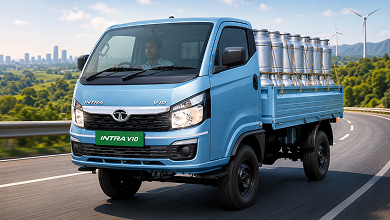
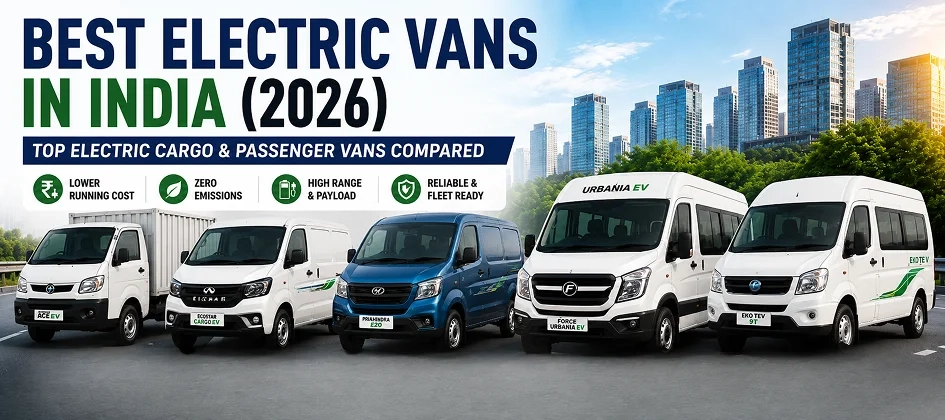
Commercial transport in India is undergoing a massive shift. Rising diesel prices, strict urban emissions zones, and expanding e-commerce networks have made last-mile logistics companies re-examine their daily operating costs. For fleet operators and business owners, transitioning to the best electric vans in India is no longer just an environmental decision; it is a straightforward financial move that significantly cuts per-kilometre expenses.
From compact urban delivery vans navigating narrow city alleys in Mumbai or Delhi NCR to spacious passenger shuttles operating in tech corridors across Bengaluru and Hyderabad, electric commercial vehicles have proven their durability. Modern electric vans offer high load volumes, instant torque under heavy payloads, fast-charging flexibility, and running costs as low as 80 paise per kilometer. This detailed guide breaks down the top electric cargo and passenger vans available in 2026, helping you choose the ideal vehicle for your fleet or small business.
The best electric vans in India include the Tata Ace EV, Eicher E-Xpress, Mahindra Zeo, Force Urbania EV, and Eko Tev Electric. When picking a model, match your operational requirements: compact cargo vans (payloads up to 1,000 kg) work best for urban e-commerce deliveries, while heavy-duty options and high-capacity passenger vans serve shuttle operators and intercity routes efficiently.
Commercial fleets operate on thin margins where fuel and vehicle downtime directly impact profitability. Transitioning from internal combustion engines (ICE) to electric power changes the equation in three core areas:
Drastic Reduction in Fuel Overhead: Running a diesel delivery van costs between INR 6.50 and INR 8.50 per kilometre in city stop-and-go traffic. An electric van slashes that expense to INR 0.80 to INR 1.50 per km, saving thousands of rupees every month per vehicle.
Simplified Mechanical Upkeep: Electric drivetrains eliminate engine oil changes, spark plugs, clutch replacement, timing belts, and complex exhaust treatment systems, cutting maintenance bills by 40% to 50%.
Unrestricted Urban Mobility: Municipal guidelines across major metros increasingly restrict diesel commercial entry during daytime hours. Electric commercial vehicles enjoy unrestricted entry into low-emission city centres and congested business districts.
Cargo electric vans handle the heavy lifting of modern last-mile distribution, courier hubs, grocery deliveries, and industrial movement.
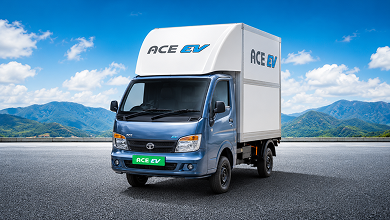
Tata Motors transformed India’s commercial transport landscape with the original Ace, and its electric counterpart continues that legacy. Powered by Tata’s Evogen powertrain, the Ace EV is purpose-built for high-frequency urban routes.
Payload Capacity: 600 kg
Claimed Range: 154 km (Certified) / 100–120 km (Real World)
Motor & Battery: 27 kW Motor / 21.3 kWh LFP Battery
Price Range: INR 9.21 Lakh – INR 10.00 Lakh (Ex-Showroom)
Best For: E-commerce delivery, courier networks, and FMCG distribution.
Mahindra's Zeo commercial EV platform addresses urban express distribution with a focus on interior driver comfort, high torque delivery, and quick top-up charging capabilities.
Payload Capacity: 765 kg
Claimed Range: 160 km
Motor & Battery: 30 kW Motor / 21.3 kWh Battery
Price Range: INR 7.52 Lakh – INR 8.20 Lakh (Ex-Showroom)
Best For: Fresh food supply chains, retail stock transfers, laundry and linen services.
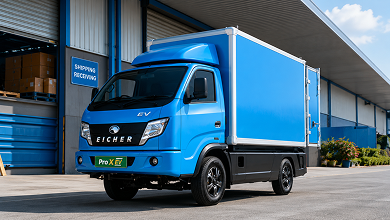
Built specifically for commercial logistics by VE Commercial Vehicles (a Volvo Group and Eicher joint venture), the E-Xpress delivers high volumetric storage space alongside robust telematics for real-time fleet monitoring.
Payload Capacity: 1,000 kg
Claimed Range: 180 km
Motor & Battery: 40 kW Peak Power / 30 kWh Battery
Price Range: INR 11.50 Lakh – INR 13.00 Lakh (Ex-Showroom)
Best For: Heavy parcel cargo, industrial spare parts, and high-density urban deliveries.
Passenger electric vans cater to corporate employee transport, hotel shuttles, school transport, and premium tour operators seeking silent, zero-emission transit.
Based on Force Motors' popular monocoque platform, the Urbania EV brings comfortable seating, high headroom, and long-range capabilities to corporate commuter fleets.
Seating Capacity: 10 to 13 Passengers
Claimed Range: 220–250 km
Charging Time: Fast DC charge to 80% in 50 minutes
Price Range: INR 28.00 Lakh – INR 32.00 Lakh (Ex-Showroom)
Best For: Corporate employee transit, luxury tourism, and airport shuttles.
Eko Vehicles offers entry-to-mid-tier passenger shuttles focused on cost-effective campus transit, university transport, and localised intra-city routes.
Seating Capacity: 6 to 9 Passengers
Claimed Range: 120–140 km
Price Range: INR 10.50 Lakh – iNR 12.50 Lakh (Ex-Showroom)
Best For: Hospital staff movement, educational institutions, and private township mobility.
| Vehicle Model | Category | Payload / Seating | Real-World Range | Battery Capacity | Fast Charging (0-80%) | Ex-Showroom Price (Approx.) |
| Tata Ace EV | Cargo Van | 600 kg | 110–120 km | 21.3 kWh LFP | ~105 mins (Fast) | INR 9.21 - 10.00 Lakh |
| Mahindra Zeo | Cargo Van | 765 kg | 115–125 km | 21.3 kWh LFP | ~60 mins (DC) | INR 7.52 - 8.20 Lakh |
| Eicher E-Xpress | Heavy Cargo | 1,000 kg | 140–150 km | 30.0 kWh LFP | ~75 mins (DC) | INR 11.50 - 13.00 Lakh |
| Force Urbania EV | Passenger | 10–13 Seats | 180–210 km | 45–50 kWh LFP | ~50 mins (DC) | INR 28.00 - 32.00 Lakh |
| Eko Tev Shuttle | Passenger | 6–9 Seats | 100–120 km | 18.5 kWh Lithium | ~120 mins | INR 10.50 - 12.50 Lakh |
Buying a commercial electric van differs significantly from purchasing a personal car. Follow this structured roadmap to evaluate your operational readiness:
1. Analyse Daily Payload and Cargo Volume Needs:
Calculate the average weight and volumetric space your goods occupy. Do not pay for a 1,000 kg payload capacity if your daily parcel delivery route carries lightweight, high-volume items under 400 kg.
2. Determine Fixed Daily Route Distance:
Review your GPS fleet data for average daily run lengths. Match this against real-world range figures (accounting for air conditioning and loaded weight) rather than manufacturer test claims.
3. Inspect Charging Power at Depot or Warehouse:
Ensure your primary parking area or warehouse has adequate connected electrical load. Installing a three-phase 11 kW or 22 kW AC charger requires coordination with local DISCOM utility authorities.
4. Calculate Total Cost of Ownership (TCO):
Factor in local state EV subsidies, registration exemptions, battery warranties (typically 5 years/1,500,000 km), and projected fuel savings over a 5-year operating window.
Commercial EV adoption provides concrete balance-sheet advantages:
Massive Operational Savings: Fuel bills drop by up to 75% to 80% compared to diesel options, allowing businesses to recover higher upfront vehicle costs within 24 to 30 months.
Predictable Maintenance Budgets: Fewer moving engine parts lower unexpected mechanical failures, improving overall fleet uptime.
Regenerative Braking in Traffic: In congested city centres, regenerative braking harnesses stop-and-go momentum to recharge the battery while extending brake pad life.
Enhanced ESG Compliance: Green logistics credentials help logistics providers secure contracts with global corporations prioritising carbon-neutral supply chains.
Quiet Driver Experience: Low noise, vibration, and harshness (NVH) levels reduce driver fatigue during long 8-to-10-hour delivery shifts.
Modern commercial EVs serve as connected data hubs. Look for these essential features when shopping:
Telematics & Fleet Analytics: Built-in GPS tracking, real-world State of Charge (SoC) monitoring, driver behaviour profiling, and geofencing.
Liquid-Cooled Battery Thermal Management: Essential for maintaining battery safety and health in Indian summer temperatures exceeding 45°C.
Thermal Runaway Protection: Advanced Lithium Iron Phosphate (LFP) chemistry with IP67-rated waterproof and dustproof battery enclosures.
Hill-Hold Assist: Prevents roll-backs when starting on steep loading ramps or flyovers under full payload.
Seeing how electric vans fit into everyday operations illustrates their practical value:
Fleet: 15 Tata Ace EVs
Operation: Two delivery shifts daily (6:00 AM – 1:00 PM and 3:00 PM – 9:00 PM) covering 110 km total.
Charging Strategy: Slow AC charging overnight at the central hub; 45-minute DC fast charge during midday loading.
Financial Result: Reduced monthly fleet fuel expenses from INR2.1 lakh (diesel) to under ₹38,000 (electricity).
Fleet: 4 Force Urbania EVs
Operation: Transporting IT professionals across a 15 km corridor connecting metro stations to office parks.
Financial Result: Zero noise, high passenger satisfaction, and full compliance with regional corporate sustainability goals.
Optimising your charging setup preserves battery longevity and keeps operating costs predictable:
Prioritise Overnight AC Charging: Use low-cost, slow AC chargers during overnight off-peak hours whenever possible to minimise grid demand charges and thermal strain on batteries.
Strategic Midday Top-Ups: Utilise DC fast chargers for 30-minute power top-ups during driver lunch breaks or warehouse reloading windows rather than deep, full charges.
Avoid Full Discharge: Set driver alerts to return to base when battery charge hits 15% to 20% to prevent deep-discharge degradation.
Overestimating Manufacturer-Claimed Range: Never plan daily delivery routes on 100% ideal certified range. Always subtract 20% to 25% to account for payload, traffic congestion, and summer climate control usage.
Ignoring Depot Infrastructure Upgrades: Buying 10 electric vans before verifying if your depot's transformer can handle the charging load leads to costly operational delays.
Choosing Unsuitable Battery Chemistries: Ensure your vehicle uses Lithium Iron Phosphate (LFP) chemistry, which handles thermal cycles and tropical climate heat far better than standard NMC cells.
Overlooking Driver Training: EV driving requires smooth throttle control and smart use of regenerative braking. Untrained drivers can reduce vehicle efficiency by up to 20%.
Commercial EV batteries represent a major portion of the vehicle's initial value. Extend their operating life with these three practices:
Maintain the 20% to 80% Charge Band: For routine daily operations, charging the battery up to 80%–90% for standard runs reduces cell wear over time.
Cooling Off Before Charging: Instruct drivers not to plug into high-power DC fast chargers immediately after a long high-speed run on hot asphalt. Allow the thermal system 15 minutes to stabilize cell temperatures.
Utilize Scheduled Pre-Conditioning: If your vehicle supports smart telematics, schedule cabin pre-cooling while the van is still plugged into grid power before morning departures.
Selecting the best electric van in India comes down to matching vehicle specifications with your core business model:
For Small Business & E-Commerce Delivery: Choose the Mahindra Zeo or Tata Ace EV. They offer low entry prices, nimble handling in crowded market streets, and proven nationwide service support.
For Heavy Last-Mile Cargo: Select the Eicher E-Xpress EV. Its 1,000 kg payload capacity and sturdy chassis handle heavy industrial goods and bulk courier loads easily.
For Corporate & Passenger Transport: Invest in the Force Urbania EV. Its refined passenger cabin, smooth electric drive, and high seating capacity make it ideal for high-end corporate transport and hotel shuttle services.


Manage reminders, payment status, and renewal dates from one simple app.


Trusted by policyholders to track every renewal.