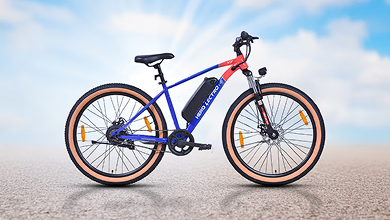
Choosing between an electric bicycle vs a normal bicycle is one of the most practical decisions urban commuters and fitness seekers face today. With petrol prices staying consistently high and traffic congestion clogging city streets across India, pedal-powered and battery-assisted two-wheelers have evolved from niche novelties into mainstream daily transportation.
Whether you are navigating a humid 10-kilometre morning commute in Mumbai, tackling gentle inclines in Bengaluru, or simply looking for an eco-friendly way to stay active, both cycle types offer distinct advantages. But while a traditional pushbike relies purely on muscle power, an electric bicycle uses a battery and motor to assist your pedalling. The right pick ultimately hinges on your daily travel distance, physical goals, monthly budget, and personal patience for maintenance.
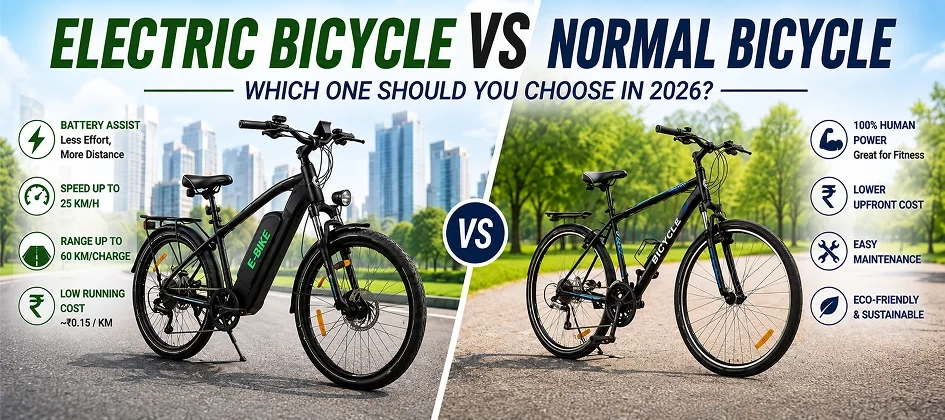
An electric bicycle uses a rechargeable battery and hub motor (typically 250W) to assist your pedaling, making it ideal for sweat-free daily commutes over 8–20 km. A normal bicycle relies entirely on human muscle, costing significantly less upfront with zero battery replacement expenses, making it superior for pure fitness training and short neighborhood trips under 5 km.
To choose effectively, it helps to understand how pedal assist actually functions on a technical level.
A traditional cycle operates via mechanical drivetrain kinetics: your feet push the pedals, which turn the chainring, driving the rear wheel via a chain or belt. It requires continuous physical exertion. Upgrades include multi-speed derailleur gears (such as Shimano 7-speed or 21-speed setups) that adjust gear ratios for steep climbs or flat sprints, but every watt of propulsion comes directly from your legs.
An electric cycle integrates three core electronic components onto a standard bicycle frame:
BLDC Motor: Usually a 250W rear hub motor capped legally at 25 km/h in India so riders don't need a licence or registration.
Lithium-Ion Battery Pack: Typically ranging from 36V 5.2Ah to 36V 13Ah, mounted on the downtube or frame interior.
Pedal Assist Sensor (PAS) / Throttle: Detects pedal cadence and delivers proportional motor torque to lighten your leg effort.
Here is a side-by-side technical and operational breakdown across key parameters.
| Feature / Attribute | Electric Bicycle (E-Bike) | Normal Bicycle (Traditional Cycle) |
| Propulsion Source | Human pedaling + Electric motor assist | 100% Human muscular power |
| Upfront Purchase Cost | INR 18,000 – ₹55,000+ | INR 6,000 – ₹22,000 |
| Top Assisted Speed | 25 km/h (legal limit for non-licensed EVs) | 15–22 km/h (depends on rider fitness) |
| Average Effort Required | Low to Moderate (Adjustable PAS levels) | High (Continuous cardiovascular effort) |
| Typical Total Weight | 18 kg – 26 kg | 11 kg – 16 kg |
| Effective Single-Trip Distance | 25 km – 60 km per charge | 5 km – 15 km (before physical fatigue) |
| Running Cost | ~INR 0.15 / km (electricity charge) | INR 0 / km |
| License & Registration | Not required (for 250W / 25km/h models) | Not required |
| Battery Lifespan | 2 – 4 years (700–1000 charge cycles) | N/A |
| Maintenance Complexity | Moderate (Mechanical + Electronic checks) | Very Low (Standard mechanical adjustments) |
When comparing an electric bicycle vs a normal bicycle, price is usually the first major decision factor.
Normal Bicycle: Entry-level single-speed cycles start around INR 6,000 to INR 9,000, while quality hybrid or alloy-frame multi-gear bikes (Hero, Firefox, and Montra) sit between INR 12,000 and INR 22,000.
Electric Bicycle: Quality entry-level e-cycles (Hero Lectro, Voltebyk, and EMotorad) start at roughly INR 18,000 to INR 25,000, while mid-range models featuring detachable 10 Ah+ batteries, front suspension, and dual disc brakes span INR 28,000 to INR 45,000.
Running an electric bike costs roughly 15 paise per kilometre in electricity. Fully charging a 36V 7.8Ah lithium-ion battery consumes under 0.3 units of electricity amounting to less than INR 2.50 per charge for a 35-40 km real-world range.
However, factor in battery replacement costs. Lithium-ion batteries gradually lose capacity after 3 to 4 years of daily charging. Replacing a 36V e-cycle pack costs between INR 6,000 and ₹11,000.
The single biggest advantage of an electric bike for office commuters is the ability to show up clean and sweat-free. On a standard bicycle, riding 10 kilometres through 32°C morning heat leaves most people drenched in sweat. With pedal-assist level 3 or a full-twist throttle engaged on an e-bike, your heart rate remains steady while you cruise comfortably at 22–25 km/h.
In hilly cities or areas with frequent flyovers (such as Delhi NCR or suburban Mumbai), a standard bicycle requires significant leg torque, forcing many riders to dismount and push. An e-bike's motor delivers instant low-end torque, flattening inclines with minimal extra leg exertion.
A common misconception is that electric bicycles provide no workout benefits because the motor "does all the work". Science and real-world telemetry say otherwise.
If your primary goal is maximum calorie burn per minute, the traditional bicycle wins. A 30-minute intense ride on a manual cycle burns roughly 250 to 400 calories depending on your speed and terrain. It builds quadriceps, calves, and cardiovascular resistance rapidly.
Multiple health studies confirm that e-bike owners tend to ride longer distances and more frequently than traditional bike owners. Because the intimidation factor of steep hills and exhaustion is removed, riders take their e-bikes for daily errands they would otherwise complete by car or scooter.
Pedal-assist lets you dial in your exertion level.
Low Assist (Level 1): Great active workout; motor compensates only for bike weight.
Medium Assist (Level 2): Gentle aerobic exercise, ideal for active recovery.
High Assist / Throttle: Restful mobility for tired days or hot afternoons.
A traditional bike is mechanically simple. Regular care involves:
Cleaning and lubricating the drive chain every 200–300 km.
Checking tyre pressure weekly.
Replacing rubber rim brake pads or disc brake pads once or twice a year.
Adjusting derailleur gear cables when shifting feels clunky.
Any neighbourhood roadside mechanic in India can repair a standard cycle in under 20 minutes for a nominal fee.
An e-bike includes all standard cycle mechanics plus electrical components. Extra care includes:
Battery Protection: Storing the battery indoors away from direct monsoon rain or scorching summer heat (above 45°C).
Motor & Wiring Inspections: Checking cable connectors near the hub motor for wear or moisture ingress.
Brake Wear: Because e-bikes weigh 5–10 kg more and travel at higher average speeds, brake pads wear down roughly 20–30% faster.
If you are on the fence between an electric cycle and a traditional one, follow this decision process:
1. Measure Your Single-Trip Daily Commute:
If your daily one-way distance is under 4 km, a standard bicycle is lightweight and sufficient. If your single trip exceeds 6–8 km, an electric bicycle will save you significant energy and time.
2. Evaluate Route Elevation & Weather:
Identify flyovers, steep inclines, or heavy afternoon heat along your route. High elevations or hot climates heavily favour an electric cycle's pedal-assist capabilities.
3. Verify Parking & Power Options:
Ensure you have access to a standard 5A/15 A wall socket near your parking spot, or choose an e-bike model with a detachable battery so you can carry the pack indoors to charge at your desk or apartment.
4. Compare Total 3-Year Ownership Costs:
Factor in the initial cost plus battery replacement after year 3 for e-bikes versus simple mechanical maintenance for regular cycles. Choose the option that fits your long-term monthly financial comfort.
Sweat-Free Office Commutes: Arrive at work fresh without needing a shower or change of clothes.
Extended Travel Radius: Easily travel 20–30 km in a single session without physical exhaustion.
Inclusivity for All Ages: Allows senior citizens or riders recovering from joint injuries to cycle without straining knees.
Time Consistency: Maintains a stable 20–25 km/h average speed regardless of fatigue or headwind.
Unbeatable Affordability: Lower purchase cost and virtually zero operational expenses.
Ultra-Lightweight Handling: Easy to carry up apartment staircases or hoist onto car racks.
Maximum Caloric Burn: Higher physical intensity per kilometre for pure weight-loss goals.
Zero Battery Anxiety: Infinite range powered solely by your physical stamina.
When shopping in 2026, keep an eye out for these essential specifications:
Detachable Lithium-Ion Battery: Essential for apartment dwellers who cannot park near a ground-floor plug.
Dual Disc Brakes: Crucial for safe stopping power given the added mass and speed of an e-bike.
Front Suspension Fork: Cushioning on pothole-ridden city streets.
IP65/IP67 Waterproofing: Protects the controller, battery enclosure, and LED screen during monsoon rains.
Alloy Frame (6061 Aluminium): Lighter and rust-resistant compared to traditional heavy steel frames.
Quick-Release Wheels & Seatpost: Simplifies puncture repairs and height adjustments.
Wide-Range Gearing: A 7-speed or 21-speed setup helps match cadence to flat roads and gentle hills.
To see how these two options play out in everyday life, consider these user profiles:
Commute: 11 km each way from HSR Layout to Manyata Tech Park.
Choice: Electric Bicycle (36V, 10 Ah, Detachable Battery).
Outcome: Completes the 11 km trip in 32 minutes flat, faster than cars stuck in Outer Ring Road traffic. Uses pedal-assist level 2, arriving at work without sweating.
Commute: 4 km neighbourhood rides + weekend 25 km morning fitness loops.
Choice: Normal Hybrid Bicycle (Alloy Frame, 21-Speed Shimano).
Outcome: Enjoys lightweight handling and low maintenance. Uses the bike primarily for high-heart-rate morning workouts along riverfront paths.
Regardless of which frame you select, following these guidelines ensures a safe, efficient ride:
Wear a Helmet: Head protection is essential when sharing roads with motorised traffic at speeds up to 25 km/h.
Use High-Visibility Lighting: Equipping front white LED lights and rear flashing red lights drastically improves safety during dusk and dawn rides.
Maintain Correct Tyre Pressure: Keeping tyres inflated to the recommended PSI (typically 45–60 PSI for hybrid/city tyres) prevents pinch flats and improves battery range or pedalling efficiency.
Buying an Overly Heavy Steel E-Bike: Heavy steel-frame e-bikes (25+ kg) are difficult to pedal if the battery runs flat mid-ride. Look for aluminium alloy frames whenever possible.
Ignoring Battery Detachability: Buying a fixed-battery e-bike when you live on the 3rd floor without an elevator or ground-floor power outlet creates major charging headaches.
Choosing Low-Quality Mechanical Brakes: E-bikes carry momentum quickly. Relying on cheap rim V-brakes leads to long stopping distances. Opt for dual disc brakes.
Expecting E-Bikes to Act Like Petrol Scooters: E-bikes are meant for efficient gliding and assisted pedalling, not carrying heavy three-passenger loads or pulling massive cargo trailers uphill.
If you opt for an electric bicycle, adopting smart battery habits can add 12–18 months to your battery's operational lifespan:
The 20–80% Rule: Avoid letting the battery drain to 0% completely. Recharge when it drops to around 20%, and unplug near 80–90% if you aren't embarking on a maximum-range ride right away.
Never Charge Hot: Let the battery cool down for 20 minutes after a long ride before connecting the charger.
Store at Room Temperature: Extreme heat degrades lithium cells rapidly. Park your battery in shaded, well-ventilated areas.
Your daily commute is longer than 6–8 km each way.
You want to commute in professional clothes without sweating.
Your route includes flyovers or rolling hills.
You are returning to cycling after a long break or managing joint sensitivities.
Your daily riding is strictly under 4–5 km.
Your primary goal is intense physical exercise and calorie burning.
Your budget is strictly below INR 15,000.
You want a light bike that is zero-maintenance and easy to carry.


Manage reminders, payment status, and renewal dates from one simple app.


Trusted by policyholders to track every renewal.