Ask any auto-rickshaw driver in Lucknow or Coimbatore what CNG costs them by month's end, and you'll get an answer with real frustration behind it. Fuel is the single biggest expense eating into a rickshaw operator's daily earnings, and it's the one cost that never moves in the driver's favour.
That's the practical reason India's electric rickshaw segment has grown into a genuinely serious category rather than a fringe experiment. Electric autos now cost roughly INR 0.40-0.70 per km to run, against INR 1.80-2.50 per km for CNG, a gap wide enough that many operators recover their higher upfront cost within the first year or two of daily use. Three-wheelers, in fact, now make up around 60% of India's total commercial EV segment, and electric variants are steadily eating into that share.
This guide covers the best electric rickshaws in India for 2026, split across passenger and cargo use, budget and premium brackets, so you can match the right model to your actual route and business.
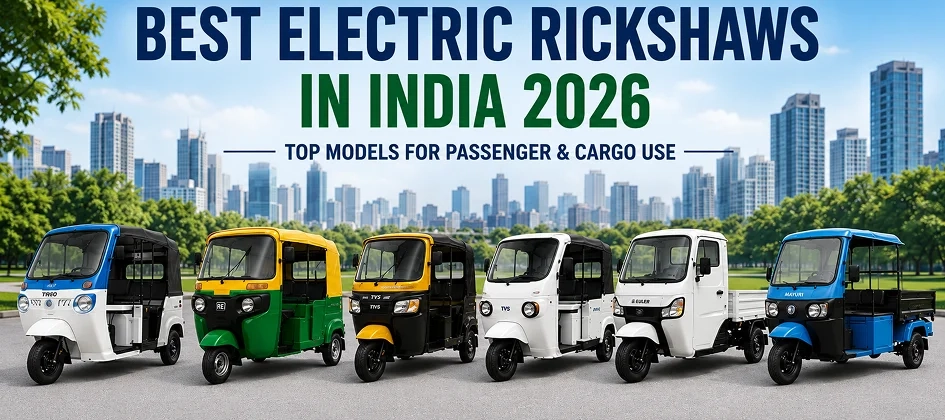
The best electric rickshaws in India for 2026 include the Mahindra Treo Plus (best overall passenger e-rickshaw), Bajaj RE E TEC 9.0 (INR 1.20-1.50 lakh, 178 km range), TVS King EV MAX (179 km range, strong in South India), and Piaggio Ape E-City (premium comfort with swappable battery support). For cargo use, the Euler HiLoad EV leads in heavy-duty delivery applications.
Why Electric Rickshaws Are Growing Fast in India
Three-wheelers hold a unique place in India's transport economy; they're often the first vehicle a small transport entrepreneur ever owns, and the running cost math has shifted decisively in favour of electric vehicles in the last couple of years.
Running costs are dramatically lower. Electric autos cost roughly INR 0.40-0.70 per km to operate in most Indian cities, compared to INR 1.80-2.50 per km for CNG alternatives, a difference that adds up fast for a vehicle doing 100+ km a day.
Established brands have entered seriously. This isn't just a market of unorganised, lead-acid-battery manufacturers anymore. Bajaj, Mahindra, TVS, and Piaggio, the same names drivers already trust for CNG and petrol autos, now field genuine lithium-ion electric variants with proper service networks behind them.
Market share reflects real adoption. According to FADA's June 2026 data, Bajaj Auto leads the overall three-wheeler market with a 34% share, followed by Mahindra at 11%, and electric variants are an increasingly significant part of that volume as drivers switch from CNG.
Types of Electric Rickshaws
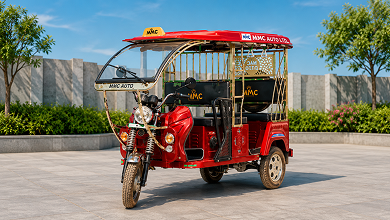
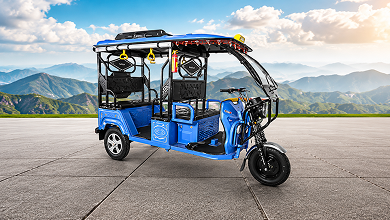
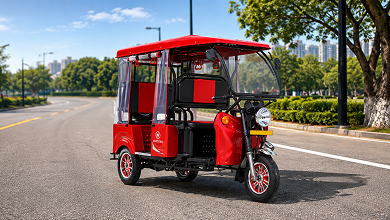
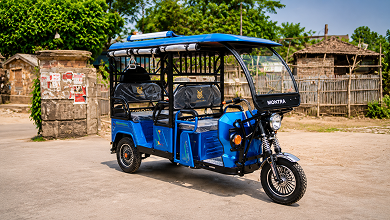
Passenger E-Rickshaws (E-Autos) Built for carrying passengers on short city routes, these are the electric equivalent of the traditional CNG or petrol auto-rickshaw, with a driver's cabin and rear passenger seating.
Cargo E-Rickshaws: Built for carrying goods rather than passengers, these serve last-mile delivery, small business transport, and local logistics, with an open or enclosed cargo bed replacing passenger seating.
Loader/Heavy-Duty E-Rickshaws: A step up from standard cargo variants, models like the Euler HiLoad EV are built for higher payload capacity, serving businesses that need more than a standard e-rickshaw's carrying capacity.
Best Passenger Electric Rickshaws
1. Mahindra Treo Plus: Best Overall Passenger E-Rickshaw
Widely regarded as the strongest all-round electric auto-rickshaw in India for 2026, the Treo Plus combines solid range, a well-established service network, strong battery warranty terms, and the kind of ownership confidence that comes from Mahindra's long track record in electric three-wheelers.
Best for: Operators prioritising reliability and long-term ownership confidence over the lowest upfront price.
2. Bajaj RE E TEC 9.0: Best for Existing Bajaj Drivers
Priced between INR 1.20 and 1.50 lakh, the RE E TEC 9.0 offers up to 178 km per charge from one of the largest battery packs in its class at 8.9 kWh, along with a two-speed automatic transmission and internal battery charging that skips the need for external charging equipment. Its biggest advantage is familiarity; existing Bajaj RE drivers can transition to this model with minimal adjustment to driving habits.
Best for: Drivers already familiar with Bajaj's traditional RE platform looking for a low-friction switch to electric.
3. TVS King EV MAX: Best for South Indian Operations
Offering a range of up to 179 km per charge, the King EV MAX is the electric version of TVS's well-established King Deluxe platform and has found particularly strong traction in South India, where TVS already has a dense dealer and service presence.
Best for: Operators in South Indian cities wanting strong regional service backup.
4. Piaggio Ape E-City: Best for Premium Passenger Comfort
The Ape E-City brings a wider, more comfortable passenger cabin than many competitors, along with a distinctive swap-bot battery system that lets drivers exchange a depleted battery for a fully charged one at supported charging stations, cutting down on downtime. It also holds the distinction of being among the first three-wheelers in India to combine this kind of swappable battery infrastructure with passenger comfort features.
Best for: Operators running premium city routes where passenger comfort influences repeat ridership.
Best Cargo Electric Rickshaws
5. Euler HiLoad EV: Best for Heavy-Duty Cargo
Built specifically for both passenger and cargo transport in a heavy-duty configuration, the HiLoad EV serves businesses needing more payload capacity than a standard e-rickshaw offers, making it a strong choice for last-mile delivery operations handling bulkier loads.
Best for: E-commerce and FMCG delivery businesses needing a higher payload than standard cargo autos.
6. Mahindra Treo (Cargo Variant): Best for Small Business Logistics
Sharing its core reliability with the passenger Treo Plus, the cargo variant serves small business owners and delivery operators who want Mahindra's established service backing on a load-carrying three-wheeler.
Best for: Small business owners running local delivery routes.
- SN Solar Energy New Passenger Electric Among the most affordable options in the market, priced between INR 58,000 and 63,000, it is suited to operators prioritising the lowest possible upfront cost.
- YC Electric Yatri / Yatri Deluxe Positioned as a budget-friendly, low-maintenance option popular among small transport operators, particularly in North India.
- City Life Standard Plus XV850E A simple, easy-to-maintain option built specifically for daily commuter use on short routes.
How to Choose the Right Electric Rickshaw
- Route type: Passenger autos suit fixed city routes with predictable daily distances. Cargo variants suit delivery businesses with variable load and stop patterns.
- Battery type: Lithium-ion batteries, found in premium OEM models like Mahindra, Bajaj, and TVS, offer better longevity and faster charging than lead-acid alternatives common in budget models.
- Charging vs battery swapping: Standard charging suits operators with a fixed base to park and charge overnight. Swappable battery systems, like Piaggio's, suit operators wanting to minimise downtime during active shifts.
- Service network: Established brands with a wide dealer network reduce downtime risk significantly compared to smaller, regional manufacturers.
- Payload or seating capacity: Match the vehicle's rated capacity to your actual daily passenger or cargo load, not just the maximum spec.
Step-by-Step Guide to Buying Your First E-Rickshaw
- Decide between passenger and cargo use based on your intended business model.
- Set a realistic budget, factoring in on-road price, not just the ex-showroom figure.
- Shortlist 2-3 models from established brands with service presence in your operating city.
- Compare real-world range, not just certified figures, by talking to existing operators if possible.
- Check battery warranty terms specifically, since this is the most expensive component to eventually replace.
- Ask about financing options, since several NBFCs and manufacturers now offer e-rickshaw-specific loan schemes.
- Confirm charging or battery-swap infrastructure availability along your intended operating routes.
- Register the vehicle and complete commercial insurance before starting operations.
Benefits of Electric Rickshaws for Business
- Significantly lower running costs: INR 0.40-0.70 per km versus INR 1.80-2.50 per km for CNG.
- Reduced maintenance: fewer moving parts than a CNG or petrol engine translate to lower recurring service costs.
- Zero tailpipe emissions are increasingly relevant as cities tighten emission norms for commercial three-wheelers.
- Quieter operation is a genuine comfort improvement for both drivers and passengers over long shifts.
- Government support for the FAME scheme benefits and state-level EV subsidies continue to lower effective purchase costs, though eligibility varies by state.
Key Features to Check Before Buying
- Battery capacity and chemistry in lithium-ion packs, like the Bajaj RE E TEC 9.0's 8.9 kWh unit, generally outperform lead-acid alternatives in both range and lifespan.
- Transmission type: automatic transmissions, increasingly common in premium models, offer smoother handling than manual alternatives.
- Safety features check for tubeless radial tyres, reverse gear, side-impact beams, and hydraulic shock absorbers, all of which vary meaningfully between budget and premium models.
- GVW (Gross Vehicle Weight) rating ranges from under 1 tonne to 2.5 tonnes depending on the model, directly affecting how much passenger or cargo load the vehicle can legally and safely carry.
- Warranty coverage: battery, motor, and overall vehicle warranty terms vary significantly between established OEMs and smaller manufacturers.
Real-World Examples
An auto-rickshaw driver in Uttar Pradesh switched from a CNG auto to an Euler electric auto and reported daily running costs of around INR 200 against daily earnings reaching INR 2,000, a margin improvement widely discussed among operators comparing CNG and electric running costs on similar routes.
A Bareilly-based operator running a Sargam E Ride Deluxe MS with a lithium battery upgrade reported that the combination of a robust body and efficient battery kept maintenance costs to a minimum while delivering strong range across daily routes, according to a verified owner review on an EV listing platform.
Comparison Table
| Model Type Price |
|
ce (Ex-showroom) |
Range Best |
t For |
| SN Solar Energy New Passenger Electric |
Passenger |
INR 58,000-63,000 |
Budget-segment range |
Lowest upfront cost |
| YC Electric Yatri |
Passenger |
Budget segment |
City-focused range |
North Indian small operators |
| Bajaj RE E TEC 9.0 |
Passenger |
INR 1.20-1.50 Lakh |
Up to 178 km |
Existing Bajaj RE drivers |
| TVS King EV MAX |
Passenger |
Mid-segment |
Up to 179 km |
South India operations |
| Mahindra Treo Plus |
Passenger |
Mid-premium segment |
Strong in-class range |
Best overall reliability |
| Piaggio Ape E-City |
Passenger |
Premium segment |
Swappable battery support |
Premium comfort routes |
| Euler HiLoad EV |
Cargo (Heavy-duty) |
Higher segment |
Higher payload focus |
E-commerce, FMCG delivery |
| Erisha E Super |
Passenger (Premium) |
Up to INR 3.90 Lakh |
Premium-segment range |
High-end passenger operations |
Prices are ex-showroom estimates and vary by state, variant, and dealer. Always confirm current pricing directly with the manufacturer or an authorised dealer before purchase.
Best Practices for E-Rickshaw Owners
- Charge overnight at a fixed base rather than relying solely on public charging during active operating hours.
- Track real-world range over the first few weeks of ownership to plan realistic daily route distances.
- Keep tyre pressure and battery terminals checked regularly, since both affect range and vehicle longevity.
- Maintain service records from day one, since this supports warranty claims and resale value later.
- Join local operator groups or associations, since peer experience is often the fastest way to learn practical maintenance tips specific to your model.
Common Mistakes to Avoid
- Choosing the cheapest model without checking service network coverage. A budget e-rickshaw with no nearby service centre becomes an expensive problem the first time something breaks.
- Ignoring battery chemistry differences. Lead-acid batteries in ultra-budget models generally offer shorter lifespans and ranges than lithium-ion options in premium models.
- Overloading beyond rated GVW. This shortens battery and motor life and can create safety risks on the road.
- Skipping a total cost of ownership comparison. Factor in running costs, battery replacement, and maintenance, not just the upfront purchase price.
- Not verifying FAME or state subsidy eligibility before purchase. Subsidy availability varies by state and changes periodically, so confirm current rules rather than assuming eligibility.
Expert Tips
- If you're switching from a CNG auto, prioritise a model with a driving experience similar to what you're used to, like the Bajaj RE E TEC 9.0, to minimise the adjustment period.
- For cargo operators, weigh payload capacity and GVW rating as heavily as range, since underestimating load capacity leads to premature component wear.
- Negotiate fleet-level service contracts if you're purchasing multiple units, since several manufacturers offer discounted AMC packages for bulk commercial buyers.
- Keep a close eye on your state's specific EV subsidy and road tax policy for commercial three-wheelers, since this can materially change your effective purchase price.
Conclusion
Choosing the best electric rickshaw in India for 2026 comes down to matching the vehicle to your actual operating pattern: passenger routes versus cargo delivery, city commuting versus regional distances, and budget versus long-term reliability. The Mahindra Treo Plus remains the strongest all-round passenger choice for operators prioritising reliability, while the Bajaj RE E TEC 9.0 offers a familiar transition path for existing Bajaj drivers. Cargo operators handling heavier loads are better served by models like the Euler HiLoad EV. Whatever you choose, run the numbers on running cost against your typical CNG or petrol alternative first. For most operators doing regular daily distances, the switch pays for itself faster than the sticker price alone suggests.
FAQs
1. What is the best electric rickshaw in India for passenger transport?
The Mahindra Treo Plus is widely considered the best overall electric passenger rickshaw in India for 2026, offering a strong combination of range, reliability, service support, and battery warranty.
2. How much does an electric rickshaw cost in India?
Electric rickshaw prices in India range from around INR 58,000 for budget passenger models to INR 3.90 lakh for premium options, with most established-brand models falling between INR 41,000 and 1.5 lakh.
3. What is the running cost of an electric rickshaw compared to CNG?
Electric rickshaws typically cost INR 0.40-0.70 per km to run, compared to INR 1.80-2.50 per km for CNG alternatives, making electric rickshaws significantly cheaper for daily high-mileage use.
4. Which is the best cargo electric rickshaw for delivery businesses?
The Euler HiLoad EV is a strong choice for heavy-duty cargo applications, built specifically for higher payload capacity, suited to e-commerce and FMCG delivery businesses.
5. Are electric rickshaws eligible for subsidies in India?
Many electric rickshaws are eligible under the FAME scheme and various state-level EV policies, though eligibility and subsidy amounts vary by state and change periodically. Check current rules before purchasing.
6. What is the range of an electric rickshaw on a single charge?
Most established-brand electric rickshaws, like the Bajaj RE E TEC 9.0 and TVS King EV MAX, offer a range of 170-180 km per charge, though budget models with lead-acid batteries typically offer less.
7. Which electric rickshaw brand has the best service network in India?
Bajaj, Mahindra, and TVS have some of the widest service networks for electric rickshaws in India, given their long-established presence in the traditional auto-rickshaw market.
8. Is lithium-ion better than lead-acid for electric rickshaw batteries?
Yes, lithium-ion batteries generally offer better range, faster charging, and longer overall lifespan compared to lead-acid batteries, which are more common in budget e-rickshaw models.
9. How long does an electric rickshaw battery last?
Battery lifespan varies by chemistry and usage, with lithium-ion batteries in premium models generally lasting longer under regular daily use than lead-acid batteries in budget models, though exact lifespan depends on charging habits and load.
10. Is it worth switching from a CNG rickshaw to an electric one in 2026?
For most operators covering regular daily distances, yes, the significantly lower running cost per kilometre, combined with reduced maintenance and improving charging infrastructure, typically allows the higher upfront cost to be recovered within one to two years of regular use.