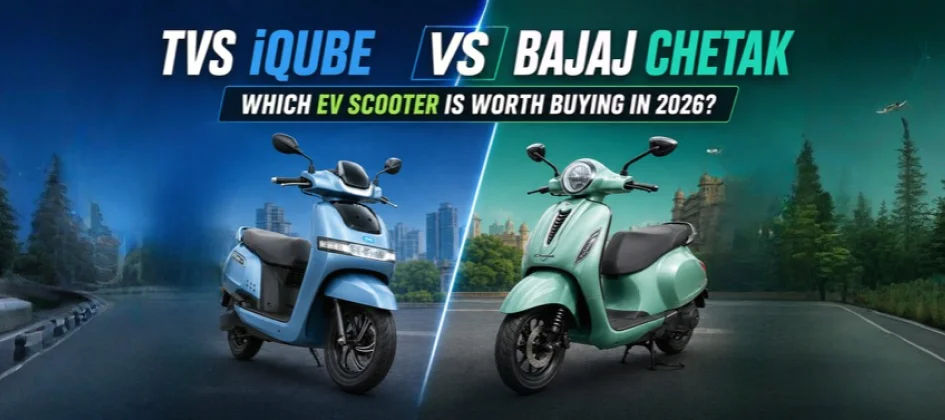
The Indian electric scooter market is more competitive than ever. Two of the most trusted names on the road are the TVS iQube and the Bajaj Chetak. Both come from established Indian manufacturing giants, bringing legendary reliability, widespread service availability, and low running costs to the table.
However, they cater to fundamentally different philosophies. The TVS iQube is a tech-forward, hyper-practical family workhorse, whereas the Bajaj Chetak is an elegant, retro-premium urban style statement.
If you are planning to make the electric switch, this definitive 2026 breakdown will help you decide which scooter deserves a spot in your garage.
| Feature | TVS iQube | Bajaj Chetak |
| Best For | Families, Tech Enthusiasts, & Daily Commuters | Style-Conscious Professionals & Premium Urban Riders |
| Build Quality | Sturdy Composite & Flat Panels | Premium All-Metal Body |
| Battery Options | 2.2 kWh to 5.3 kWh | 2.5 kWh to 3.5 kWh |
| Max Certified Range | Up to 212 km (ST Variant) | Up to 153 km (3501 Variant) |
| Storage Capacity | Segment-leading 30–32 Liters | 25 Liters |
| Instrument Cluster | Up to 17.78 cm Touchscreen TFT | Reverse LCD / Color LCD Display |
| Starting Price (Ex-Showroom) | ~INR 100,822 | ~INR 91,399 |
Price is the ultimate deciding factor for most EV buyers. Both brands have aggressively diversified their line-ups to target different budgets.
TVS offers an expansive line-up with multiple battery configurations ($2.2\text{ kWh}$, $3.1\text{ kWh}$, $3.5\text{ kWh}$, $4.7\text{ kWh}$, and the powerhouse $5.3\text{ kWh}$ ST). Prices kick off at an effective INR 1,008.22 (ex-showroom Delhi with PM E-Drive) for the base model, climbing up to INR 1,738.77 for the top-tier ST model. The mid-tier sweet spot is the newly introduced iQube S ($4.7\text{ kWh}$), priced at INR 140,142.
Bajaj structures their lineup across the 25 and 35 series (including the C2501, C3001, and C3501 variants). Bajaj lowered the barrier to entry with the budget-friendly Chetak C2501, starting at an attractive INR 91,399 (ex-showroom). The top-of-the-line premium variant maxes out around INR 142,507. Note that unlocking advanced software features requires an additional purchase of the 'TecPac.'
Winner: TVS iQube (for Flexibility) | Bajaj Chetak (for Lower Starting Price)
If you want granular control over how much range you are paying for, TVS offers better variant choices. If you want the lowest entry price for a legacy brand, the Chetak C2501 wins.
The iQube leans into a clean, minimalist, and universally appealing futuristic look. It features crisp lines, a conventional upright family stance, large flat surfaces, and a bright, robotic LED headlight setup. It is built using high-grade plastics and composite panels.
The Chetak is an absolute design triumph for those who love classic aesthetics. It retains its iconic, neo-classical, horseshoe-shaped LED DRL front end, clean flowing curves, and a premium seamless finish. Crucially, the Chetak boasts an all-metal body construction. It feels incredibly robust, has great road presence, and resists the typical wear-and-tear of tight city parking far better.
Winner: Bajaj Chetak
The timeless retro aesthetics combined with a solid, lifeproof metal body gives the Chetak an undeniable premium edge.
The Numbers: The massive range variant ($5.3\text{ kWh}$) delivers an incredible 212 km of certified Indian Driving Cycle (IDC) range. The popular mid-tier $4.7\text{ kWh}$ variant claims 175 km of IDC range, paired with a $4.4\text{ kW}$ hub motor hitting a top speed of 82 km/h.
Ride Quality: Acceleration is buttery smooth, linear, and utterly predictable. Thanks to its low-slung battery placement under the floorboard and a plush, softer telescopic suspension setup, it glides over city potholes with complete composure.
The Numbers: The baseline C2501 offers a 113 km range from a $2.5\text{ kWh}$ pack (top speed 55 km/h). The higher-end 35 Series variants utilize a $3.5\text{ kWh}$ pack to deliver a 153 km certified range and a snappier top speed of 73 km/h.
Ride Quality: The Chetak offers a stiffer, more European ride quality that feels incredibly planted at high speeds. Cornering feels sharp, stable, and confidence-inspiring, making it excellent for weaving through dense urban traffic.
Winner: TVS iQube
With a top speed of 82 km/h and massive battery options stretching real-world range over 150+ km effortlessly, the iQube is a more versatile commuter.
TVS went all-out on gadgets. Premium variants feature a gorgeous 17.78 cm touchscreen TFT dashboard controlled by a 5-way physical HMI joystick. It packs over 118 connected features, including turn-by-turn navigation, geofencing, remote charge tracking, Alexa skillset integration, crash/fall alerts, and smartwatch integration.
The Chetak keeps things slightly more traditional but highly functional. Depending on the variant, you get a clean, circular reverse LCD or a vivid color LCD display. It supports smartphone integration via Bluetooth, call alerts (accept/reject), music playback controls directly from the handlebar, and basic ride statistics. However, to access the full tech potential, you have to buy the optional TecPac software bundle.
Winner: TVS iQube
The iQube is a mobile powerhouse. The large touchscreen dashboard and superior connected features outclass the Chetak's retro-minimalist display units.
An electric scooter needs to handle chores, groceries, and pillion riders comfortably.
Under-seat Storage: The TVS iQube reigns supreme here with a massive 30 to 32-liter boot that easily swallows a full-sized helmet and shopping bags, alongside a handy built-in USB charging port. The Bajaj Chetak offers a tighter 25-liter boot space.
Floorboard Space: The iQube features a wide, flat, spacious floorboard designed to hold extra luggage hooks. The Chetak's curving floorboard is slightly more compact, prioritizing rider ergonomics over cargo capacity.
Seating: The iQube offers a wide, flat bench seat perfectly optimized for carrying two fully grown adults in total comfort. The Chetak features a newly redesigned, flatter 650 mm seat, which is excellent for individual ergonomics but slightly tighter for family duties.
Winner: TVSiQube: With superior boot space, a massivefloorboard, andd afamily-firstt seating layout, the iQube is unmatched in daily utility.
Both vehicles are phenomenal, but they serve two distinct masters.
You want a practical, no-nonsense scooter for the whole family.
You need maximum real-world range (up to 212 km) to kill range anxiety.
You love big touchscreen tech, navigation on your dash, and advanced smart features.
You need a massive under-seat boot space for groceries and daily commutes.
You are a solo or urban commuter who prioritizes elite, head-turning retro styling.
You demand an all-metal build that can take a beating and still look premium.
You want a crisp, well-balanced, and planted handling experience through tight city corners.
You want a lower entry price point into a premium legacy brand.


Manage reminders, payment status, and renewal dates from one simple app.


Trusted by policyholders to track every renewal.