Welcome Back
Please Enter your details to sign in
Forgot Password?
×
Create Your Account
Fill your information below or register with your social account.
Blogs
Home Blogs Detail
Best Electric Trucks in India (2026): Top Commercial EV Trucks for Business

Diesel truck running costs have a way of quietly eating a logistics business alive. Fuel is the single largest recurring expense on most fleets, and it's also the one cost a business owner has almost no control over; it moves with global crude prices, not with how efficiently you run your operation.

That's the practical case for electric trucks, and it's why fleet owners across e-commerce, FMCG distribution, and courier businesses are moving faster on this than most people expected even two years ago. Running cost savings of INR 1-2 per km against diesel's INR 4-5 per km aren't a rounding error on a fleet doing thousands of kilometres a month; they're the difference between a good year and a bad one.

This guide covers the best electric trucks in India for 2026, from small last-mile mini trucks to heavier logistics vehicles, with real prices, payload figures, and range data to help you match the right truck to your actual business.

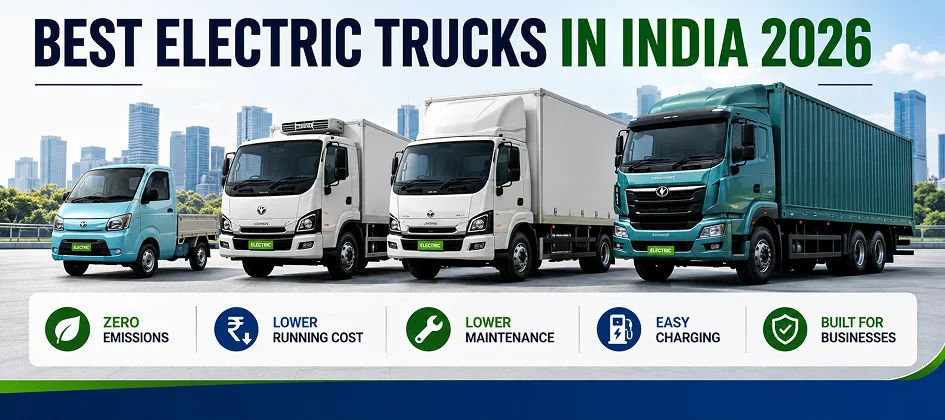
The best electric trucks in India for 2026 include the Tata Ace EV (INR 10.53-11.43 lakh, 600-1,000 kg payload) for last-mile delivery, the Euler Turbo EV 1000 (from INR 6 lakh, 1,000 kg payload) for high-frequency dispatch, the Eicher Pro 2055 EV (INR 27-30 lakh) for regional logistics, and the Ashok Leyland Boss 1218 HB EV for mid-size intercity cargo. Choice depends on payload, route distance, and budget.

Why Logistics Businesses Are Switching to Electric Trucks

India's freight and logistics sector runs on tight margins, and fuel is usually the biggest line item eating into them. Electric trucks change that equation in a fairly direct way.

Running costs drop sharply. Diesel trucks typically cost INR 4-5 per km to run once you factor in fuel alone, while electric trucks run at roughly INR 1-2 per km on electricity. On a truck covering 100+ km a day, that gap adds up to real monthly savings within the first year.

Maintenance costs fall too. Electric trucks have roughly 70% fewer moving parts than a diesel truck, meaning no oil changes, no complex exhaust after-treatment systems, and generally less unplanned downtime.

Government support continues. The FAME scheme and various state-level EV subsidies have made commercial electric trucks more accessible to purchase, though eligibility and subsidy amounts vary by state and change periodically; check your state transport department's current EV policy before finalising a purchase.

Major logistics players are already committing. Ashok Leyland has supplied fleets of electric trucks with ADAS and dual-port charging to operators running the Chennai-Bengaluru and Chennai-Vijayawada corridors, signalling that electric trucks are moving well past pilot projects into real commercial routes.

Types of Electric Trucks in India

Electric trucks in India span a wide range, and picking the right category matters as much as picking the right model.

Small Commercial Vehicles (SCVs) / Mini Trucks: Compact trucks like the Tata Ace EV sit at the entry point of India's electric truck market, built for last-mile delivery, e-commerce distribution, and short intra-city runs where manoeuvrability matters as much as payload.

Intermediate Commercial Vehicles (ICVs) Models like the Eicher Pro 2049 EV and Pro 2055 EV step up in payload and range, suited to regional distribution and businesses moving heavier volumes between city hubs.

Medium and Heavy Commercial Vehicles (M&HCVs) Ashok Leyland's Boss and AVTR EV ranges, along with Olectra's heavy tippers, serve construction, mining, and bulk haulage applications where payload capacity matters more than range efficiency.

Best Electric Mini Trucks (Under ₹15 Lakh)

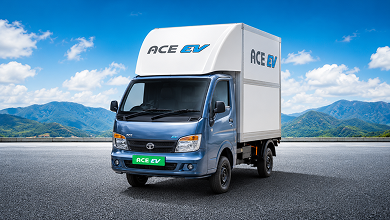
1. Tata Ace EV: Best Overall for Last-Mile Delivery

Priced between INR 10.53 and 11.43 lakh, the Tata Ace EV runs a 21.3 kWh battery with an ARAI-certified range of around 154 km and a payload capacity of 600-1,000 kg. Its leaf-spring suspension is built for repeated daily loading, and Tata's extensive service network makes it a low-risk choice for first-time electric fleet buyers.

Best for: E-commerce sellers, FMCG distributors, small businesses needing dependable daily cargo runs.

2. Euler Turbo EV 1000: Best Budget Option for High-Frequency Dispatch

Starting from INR 6 lakh, the Turbo EV 1000 is currently the most affordable electric truck in India, offering a 1,000 kg payload with fast-charging support that reduces vehicle downtime between shifts. It's widely used by courier and e-commerce operators running multiple trips a day.

Best for: High-volume operators prioritising low upfront cost and quick charging turnaround.

3. Mahindra ZEO: Best for Balanced Payload and Price

Priced between INR 7.88 and 8.37 lakh, the ZEO offers a practical middle ground for businesses wanting a proven Mahindra badge without stepping up to the Ace EV's price point.

Best for: MSMEs and first-time electric fleet buyers on a tighter budget.

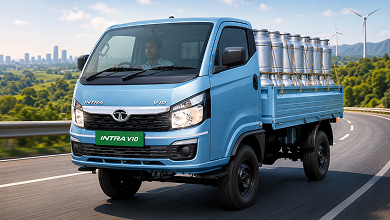
4. Tata Intra EV Pickup: Best for Mixed Cargo Applications

Priced around INR 11.95 lakh, the Intra EV Pickup offers open-deck flexibility, useful for businesses handling irregular or oversized cargo that doesn't fit a standard closed body.

Best for: Construction material transport, mixed-load small businesses.

Best Electric ICVs and Mid-Size Trucks (INR 15-30 Lakh)

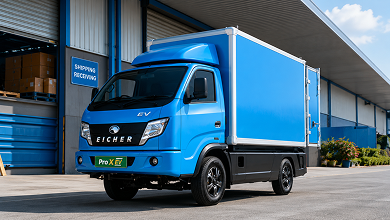
5. Eicher Pro 2049 EV: Best for Intra-City Bulk Distribution

Running a 64 kWh battery with a range of about 174 km, the Pro 2049 EV is built for businesses distributing higher volumes across a city rather than a single neighbourhood.

Best for: Warehouse and distribution companies, FMCG logistics.

6. Eicher Pro 2055 EV Best for Regional Logistics

Priced between INR 27 and 30 lakh, the Pro 2055 EV features a Gross Vehicle Weight of 5,450 kg, fast-charging technology, and a day-cab design suited to regional routes beyond pure intra-city work.

Best for: Regional distributors and businesses moving between city hubs.

7. Ashok Leyland Boss 1218 HB EV Best for Mid-Size Intercity Cargo

Positioned in the INR 13.75-17.45 lakh bracket alongside the Tata Ultra E.9, this model is built for businesses needing more capacity than a mini truck without moving into heavy-duty pricing.

Best for: Growing logistics businesses scaling beyond last-mile delivery.

Best Electric Heavy-Duty Trucks (INR 30 Lakh+)

8. Ashok Leyland AVTR Series EV

Priced up to INR 1.25 crore depending on configuration, the AVTR EV range serves heavy haulage applications, offering the same modular customisation Ashok Leyland is known for in its diesel AVTR platform, now in an electric drivetrain.

Best for: Large logistics companies and construction firms with heavy, high-value cargo needs.

9. Olectra Meghaetron Electric Tipper

India's highest-priced electric truck at around INR 1.55 crore, built specifically for construction and mining applications requiring heavy tipper functionality.

Best for: Construction companies and mining operations transitioning to electric heavy equipment.

How to Choose the Right Electric Truck for Your Business

  • Daily distance: Mini-trucks with a 150-180 km range suit last-mile and intra-city routes. Longer regional routes need ICV or M&HCV models with higher-capacity batteries and fast-charging support.
  • Payload: Weigh your typical daily cargo, not your heaviest occasional load. Overloading shortens battery life and can void warranties.
  • Charging access: Depot or hub charging is simplest for fleet operations. If relying on public charging along routes, confirm density before committing to longer-haul electric trucks.
  • Route type: Mini trucks excel in congested city lanes. ICVs and M&HCVs handle mixed city-highway routes and heavier loads better.
  • Total cost of ownership: Compare purchase price, subsidy eligibility, insurance, battery warranty, and expected resale value, not just the ex-showroom sticker price.

Step-by-Step Guide to Buying Your First Electric Truck

  1. Audit your delivery and freight routes: note average distance, load frequency, and typical cargo weight over a representative week.
  2. Shortlist 2-3 truck categories based on that audit: mini truck, ICV, or M&HCV.
  3. Compare real-world range, not just ARAI figures. Ask existing fleet operators what range they actually see under full load.
  4. Check state EV subsidies and FAME eligibility for your shortlisted models.
  5. Test drive under load if possible, since an empty test drive won't reveal real-world range or handling.
  6. Evaluate financing and leasing options, since several NBFCs now offer EV-specific commercial vehicle loan products.
  7. Confirm service network coverage in your operating cities before signing.
  8. Buy commercial vehicle insurance that specifically covers battery and motor components, not just a standard policy.

Benefits of Electric Trucks for Business

  • Significantly lower running costs, roughly ₹1-2 per km versus ₹4-5 per km for diesel.
  • Reduced maintenance: around 70% fewer moving parts than a diesel truck means fewer scheduled services and less unplanned downtime.
  • Zero tailpipe emissions are useful for businesses working with sustainability-conscious corporate or retail clients.
  • Quieter operation helpful for early-morning or late-night delivery windows in residential and commercial areas.
  • Strong low-speed torque EVs respond quickly from a standstill, which is suited to stop-start city delivery routes.

Features to Look For

  • Battery warranty: Look for 3-8 year warranty terms, and check the fine print on capacity degradation limits.
  • Fast-charging support: Reduces vehicle downtime significantly for high-frequency dispatch operations.
  • Payload rating: Always check the certified payload figure, not the marketed maximum.
  • ADAS and safety features: Increasingly available even on mid-size electric trucks, useful for regional and highway routes.
  • Telematics and GPS tracking: Standard on many newer models, useful for fleet managers monitoring multiple vehicles.

Real-World Examples

Group BillionE received a fleet of 180 electric trucks from Ashok Leyland, featuring ADAS and dual-port charging, deployed specifically on the Chennai-Bengaluru and Chennai-Vijayawada logistics corridors, a clear signal that electric trucks are now handling serious intercity freight volume, not just last-mile pilots.

Courier and FMCG distribution businesses running the Euler Turbo EV 1000 across high-frequency dispatch routes have reported meaningful annual savings compared to diesel mini trucks, largely from the lower per-kilometre energy cost across daily multi-trip schedules.

Comparison Table

Truck Category Payload Range Price (Ex-showroom) Best For
Euler Turbo EV 1000 Mini Truck 1,000 kg ~150-180 km From INR 6 Lakh High-frequency dispatch
Mahindra ZEO Mini Truck Moderate Segment-typical INR 7.88-8.37 Lakh MSMEs, first-time buyers
Tata Ace EV Mini Truck 600-1,000 kg ~154 km INR 0.53-11.43 Lakh E-commerce, distribution
Tata Intra EV Pickup Mini Truck (Open Deck) Moderate Segment-typical ~INR 11.95 Lakh Mixed cargo applications
Ashok Leyland Boss 1218 HB EV ICV Higher tonnage Segment-typical INR 13.75-17.45 Lakh Mid-size intercity cargo
Eicher Pro 2049 EV ICV Higher tonnage ~174 km Mid-segment Intra-city bulk distribution
Eicher Pro 2055 EV ICV 5,450 kg GVW Segment-typical INR 27-30 Lakh Regional logistics
Ashok Leyland AVTR EV M&HCV Heavy Segment-typical Up to INR 1.25 Crore Heavy haulage, construction

Prices are ex-showroom estimates and vary by state, variant, and dealer. Always confirm current pricing directly with the manufacturer or an authorised dealer before purchase.

Best Practices for Running an Electric Truck Fleet

  • Plan charging schedules around off-peak electricity tariffs at your depot where available.
  • Rotate drivers between vehicles to distribute wear evenly across the fleet.
  • Track real-world range per vehicle over time, since batteries degrade gradually and knowing your actual figures helps with route planning.
  • Build a relationship with a local authorised service centre before you need one urgently.
  • Insure batteries and motors separately if your policy allows it, since these are the most expensive components to replace.

Common Mistakes to Avoid

  • Buying based on brochure range alone. Real-world range under full load, in traffic, and across varied terrain is usually lower than ARAI-certified figures.
  • Ignoring depot charging infrastructure. A great electric truck is far less useful without dependable overnight charging at your base of operations.
  • Overloading beyond certified payload. This shortens battery life and can void manufacturer warranties.
  • Skipping a total cost of ownership comparison. Focusing only on purchase price without factoring in running costs, subsidies, and resale value often leads to the wrong choice for your specific route profile.
  • Not checking service network coverage across your operating routes. A cheaper truck with no nearby service centre along your regular routes becomes an expensive liability the first time something breaks down.

Expert Tips

  • Start with a small pilot batch of 2-3 electric trucks before committing to a full fleet transition to surface real operational issues early.
  • Negotiate fleet-level maintenance contracts with dealers, since many now offer discounted AMC packages for bulk commercial buyers.
  • If your routes include hilly or uneven terrain, prioritise motor torque and ground clearance over pure range figures on the spec sheet.
  • Keep a small buffer of backup vehicles during your first few months of transition, in case of unexpected downtime while your team adapts to new charging routines.

Conclusion

Choosing the best electric trucks in India for your business comes down to matching payload, range, and route profile to your actual operation, not chasing the model with the most attractive spec sheet. A courier business running short city dispatch routes gets more value from the Euler Turbo EV 1000 or Tata Ace EV, while a regional distributor moving heavier volumes across city hubs is better served by an Eicher Pro 2055 EV or Ashok Leyland Boss 1218 HB EV. Do the route and payload homework upfront, and the switch to electric trucks typically pays for itself within two to three years through significantly lower running and maintenance costs.

FAQs
1. What is the best electric truck for a small logistics business in India?
For most small logistics businesses, the Tata Ace EV or Euler Turbo EV 1000 offers a strong balance of payload, price, and reliability for last-mile and intra-city delivery routes.
2. How much does an electric truck cost in India?
Electric truck prices in India start from around INR 6 lakh for entry-level mini trucks like the Euler Turbo EV 1000 and go up to INR 1.25 crore or more for heavy-duty models like the Ashok Leyland AVTR EV range.
3. What is the running cost of an electric truck compared to diesel?
Electric trucks typically cost INR 1-2 per km to run on electricity, compared to INR 4-5 per km for diesel trucks, though actual costs depend on local electricity tariffs and vehicle efficiency.
4. How far can an electric truck travel on a single charge?
Most electric mini trucks and ICVs offer a real-world range of 150-180 km per charge, depending on load, driving conditions, and battery capacity, though this varies by model and category.
5. Are electric trucks eligible for subsidies in India?
Yes, many electric trucks are eligible under the FAME scheme and various state-level EV policies, though eligibility and subsidy amounts vary by state and change periodically. Check current rules before purchasing.
6. Which electric truck brand is best for logistics and e-commerce delivery?
Tata Motors, Eicher, and Euler Motors are among the most popular brands for logistics and e-commerce delivery, offering a range of mini trucks and ICVs suited to different payload and route requirements.
7. Do electric trucks require more maintenance than diesel trucks?
No, electric trucks generally require significantly less maintenance, with roughly 70% fewer moving parts than diesel trucks, meaning no oil changes and typically less unplanned downtime.
8. How long does it take to charge an electric truck?
Charging time varies by model and charger type. Standard charging can take 1-6 hours, while some models support fast charging that significantly reduces this for high-frequency dispatch operations.
9. Can electric trucks handle heavy cargo loads for logistics businesses?
Yes, models like the Ashok Leyland AVTR EV series and Olectra's heavy tippers are designed for higher tonnage and heavy-duty applications, while mini trucks and ICVs suit lighter last-mile and regional loads.
10. Is it worth switching to electric trucks for a logistics business in 2026?
For most urban and regional logistics operations, yes, lower running costs, reduced maintenance, and improving charging infrastructure make electric trucks increasingly practical for daily commercial use, provided route length and depot charging access are planned properly.
Latest Blogs
EV Total Cost of Ownership in India (2026): Purchase Price, Charging, Fuel & Maintenance Compared
Aug 22, 2026
EV Total Cost of Ownership in India (2026): Purchase Price, Charging, Fuel & Maintenance Compared
Is an EV really cheaper than petrol or CNG in India? Discover the true 2026 Total Cost of Ownership (TCO) across cars, b…
Read More
ABZO VS01 vs Revolt RV400 (2026): Which Electric Bike Is Better for Indian Riders?
Aug 21, 2026
ABZO VS01 vs Revolt RV400 (2026): Which Electric Bike Is Better for Indian Riders?
Comparing the ABZO VS01 and Revolt RV400? Discover which electric motorcycle suits your daily commute best with our comp…
Read More
Kia EV9 vs BMW iX (2026): Which Luxury Electric SUV Is Better?
Aug 20, 2026
Kia EV9 vs BMW iX (2026): Which Luxury Electric SUV Is Better?
Evaluating flagship luxury electric SUVs in India? Our Kia EV9 vs BMW iX comparison breaks down ex-showroom pricing (INR…
Read More
Subscribe to our
Newsletter
Subscribe to our email newsletter today to receive update
on the latest news
Policy Reminder & Tracker Pro

Never Miss a Policy Renewal

Manage reminders, payment status, and renewal dates from one simple app.

Trusted by policyholders to track every renewal.