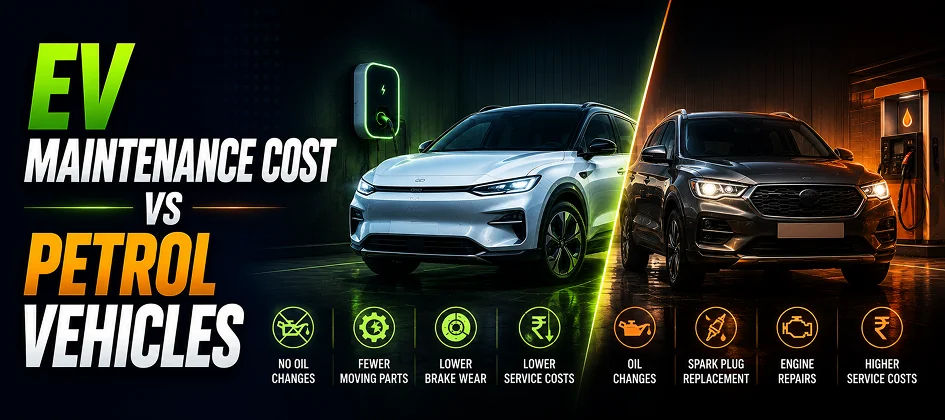
One of the biggest driving forces pushing Indian car buyers toward electric mobility is the promise of microscopic running costs. While the massive gap between electricity tariffs and fluctuating petrol prices is widely discussed, an equally critical financial question often stays in the shadows:
"Are EVs genuinely cheaper to maintain over the long haul, or do hidden service costs catch up with you?"
The data reveals a clear picture. An internal combustion engine (ICE) powertrain requires a complex dance of roughly 2,000 moving parts. An electric vehicle (EV) drivetrain scales that complexity down to roughly 20 moving components. By cutting out heavy mechanical wear, multiple friction points, and cyclic fluid changes, EV owners save between 30% and 60% on routine maintenance costs compared to petrol vehicles.
This guide provides a comprehensive, data-backed breakdown of real-world maintenance costs, scheduled service intervals, 5-year ownership math, and the insurance variables you need to know in India.
To understand where your money goes, let's map out exactly what components require replacement or servicing across both platforms:
| Maintenance Item | Electric Vehicle (EV) | Petrol Vehicle (ICE) |
| Engine Oil & Filter | Not Required | Regular changes every 10,000 km |
| Spark Plugs & Ignition | Not Required | Periodic replacement required |
| Fuel & Air Intake Filters | Not Required | Regular replacement required |
| Clutch Assembly | Not Required | Wears down: costly mid-life overhaul |
| Exhaust & Catalytic Converter | Not Required | Exhaust rust/oxygen sensor maintenance |
| Brake Pad Wear | Ultra-Low (Regenerative braking) | Standard (High friction wear) |
| Tyre Wear Profile | Accelerated (Heavy pack weight + torque) | Standard (Lighter chassis load) |
| Drivetrain Software Updates | Mandatory (Over-The-Air or OBD tools) | Minimal/Sensor diagnostics only |
For a traditional petrol car, the annual or 10,000 km service is anchored heavily around the oil change. This includes flushing the old engine oil, installing a fresh oil filter, and swapping out the engine air filter. In India, a standard workshop bill for this task averages INR 3,000 to INR 8,000 per year. With an EV, this routine expense is completely erased. There are no pistons to lubricate, no valves to seal, and no combustion residues to clean out.
Petrol cars rely entirely on physical, mechanical friction to slow down, forcing brake pads to clamp down hard on iron discs. This friction means typical front brake pads on a petrol hatchback or SUV wear out every 35,000 to 50,000 km.
EVs utilize regenerative braking. The moment you lift off the accelerator, the electric motor reverses its direction to act as a generator. This process captures the car’s kinetic energy to recharge the battery while smoothly slowing down the vehicle. Because the mechanical brake pads are reserved primarily for sudden, low-speed, or emergency stops, EV brake pads routinely last between 80,000 and 120,000 km.
As petrol vehicles cross the 50,000 km threshold, complex mechanical subsystems start demanding high-value preventative maintenance. Timing belts must be timed, fuel injection nozzles require specialized cleaning, and manual or automatic clutch systems can suffer slippage, often triggering repair bills ranging from INR 15,000 to INR 40,000.
An EV drivetrain bypasses these vulnerabilities entirely. Power flows straight from the battery pack into a single-speed reduction gearbox linked to the motor, removing traditional failure points like multi-gear transmissions and complex clutch systems.
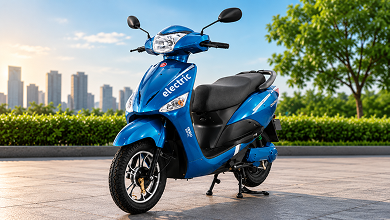
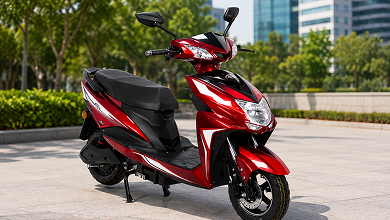
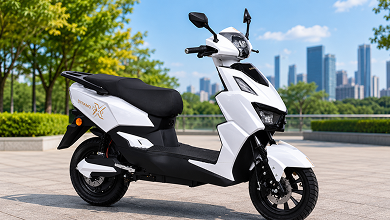
The maintenance differences are equally stark in the two-wheeler segment, which dominates Indian roads. Let’s look at a popular comparison like a 110cc-125cc petrol scooter (e.g., Honda Activa) versus a mainstream electric scooter (e.g., Ola S1 or Ather 450X).
Expected Cumulative 3-Year Service Bills:

Electric Scooter: INR 4,500 - INR 7,000
Petrol Scooter:   INR 14,000 - INR 19,000
A petrol scooter requires servicing every 3,000 to 4,000 km. During these visits, the owner must pay for engine oil top-ups, air filter cleaning or replacement, spark plug cleaning, and periodic adjustments to the CVT (Continuously Variable Transmission) drive belt and clutch rollers. Over three years, these minor, repetitive expenses add up significantly.
Electric scooters require much wider service intervals, typically every 5,000 to 10,000 km. The workshop checklist focuses almost entirely on checking the brake pad thickness, testing the steering head bearings, tightening chassis bolts, and checking the single drive belt or hub motor wiring. There are zero engine oil or filter expenses.
To put these differences into a clear economic context, let’s evaluate the real-world, 5-year cumulative maintenance projections for two corresponding mid-range SUV platforms, assuming an average driving baseline of 12,000 km per year.
Tata Nexon EV:     INR 24,000 - INR 32,000
Tata Nexon Petrol: INR 48,000 - INR 62,000
Petrol Variant: Routine maintenance bills step up significantly as the car ages. Minor first-year services hover around ₹3,500, but major third- and fourth-year appointments involving spark plug changes, brake fluid flushes, coolant replacement, and belt diagnostics routinely stretch invoices to INR 8,000 or INR 12,000.
EV Variant: Scheduled workshop visits remain highly stable, averaging INR 1,500 to INR 3,500 annually. Mechanics focus on functional structural inspections, checking the auxiliary 12V battery health, testing suspension linkages, updating powertrain firmware, and verifying the integrity of the high-voltage liquid cooling loop.
While the core mechanical savings of an EV are substantial, navigating the platform successfully requires budgeting for two distinct wear variables:
EVs carry heavy battery packs, making them significantly heavier than their petrol-powered equivalents. Additionally, electric motors deliver maximum, instantaneous torque right from a dead stop. This combination of heavy mass and instant twisting force places extra stress on tire treads. While a petrol car’s tires might easily glide past 55,000 km, EV tires typically require replacement closer to the 35,000 to 45,000 km mark. To maximize tread life, EV owners should perform routine tyre rotations every 10,000 km.
While you save money at the mechanic's workshop, you will pay a bit more to your insurance provider. A comprehensive insurance policy for an EV is generally 20% to 40% more expensive than for an equivalent petrol car.
Why? Because the Insured Declared Value (IDV) of an EV is heavily weighted by the battery pack, which comprises up to 50% of the car's entire value. If a battery is damaged in a major accident or via water ingress, the insurer faces a massive repair payout. To insulate yourself from massive out-of-pocket costs, certain insurance add-ons are considered essential for EV owners:
Zero Depreciation Cover: Absolutely non-negotiable. It ensures the insurer pays for parts replacement without deducting for age-related depreciation.
Battery/Electrical Protection Cover: Protects the pack specifically against internal short circuits, electrical power surges while fast-charging, or accidental water ingress.
Rely Primarily on Home AC Charging: Keep public DC fast chargers reserved for long road trips. Regular, slow home AC charging runs cool and flat, keeping battery cells well-balanced and protecting their long-term health.
Follow the 20-80% State of Charge Rule: For your daily commute, try to keep the battery operating between 20% and 80%. Leaving a vehicle parked for days at a time at a crisp 100% or fully drained at 0% accelerates chemical cell wear.
Keep Up with Software Updates: Modern EV performance, safety protocols, thermal control maps, and regenerative braking behavior are dictated entirely by software. Installing manufacturer updates promptly ensures your powertrain runs efficiently.
When comparing maintenance, the architectural simplicity of an electric vehicle gives it a decisive advantage. By completely removing engine oil, air filters, spark plugs, and complex multi-speed transmissions, an EV protects you from the escalating maintenance bills common to older petrol cars.
While factors like accelerated tire wear and higher upfront insurance premiums are real variables, they are quickly balanced out by minimal scheduled service invoices and exceptionally low per-kilometer running costs. If you are looking for a vehicle to serve you reliably over a multi-year horizon, choosing an EV will dramatically lower both your time spent at service stations and your long-term ownership costs.


Manage reminders, payment status, and renewal dates from one simple app.


Trusted by policyholders to track every renewal.