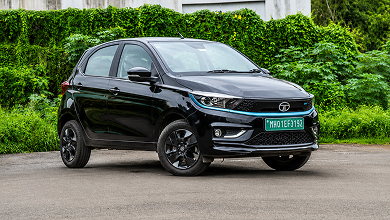
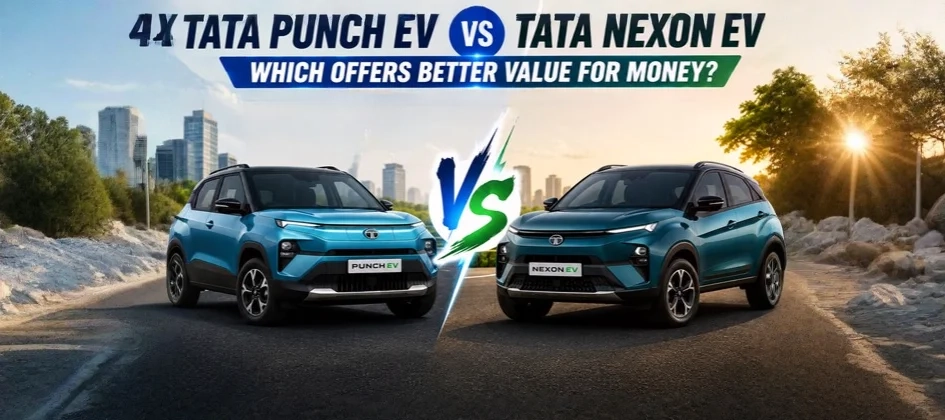
Walk into a Tata showroom wanting an electric SUV, and you'll likely get steered toward whichever one has better margin that month, not necessarily the one that fits your life. That's a normal showroom incentive, and it's exactly why the Tata Punch EV vs Nexon EV decision deserves a closer look than a five-minute conversation with a salesperson.
Both are genuinely good electric SUVs, and both wear Tata's 5-star Bharat NCAP safety rating. But they're built for different buyers, and the price gap between them, roughly INR 3 lakh at entry level, stretching to INR 5 lakh on higher variants, isn't small enough to shrug off. This comparison breaks down exactly where that extra money goes and whether it's worth spending for your specific driving pattern.
The Tata Punch EV offers better value for money for most Indian city buyers, costing roughly INR 4.9 lakh less over 5 years of ownership while delivering comparable real-world range (340-355 km vs 350-375 km) and faster DC charging. The Tata Nexon EV justifies its premium for buyers who need more cabin space, regular highway trips above 100 km, or V2L/V2V charging capability.
The 2026 Punch EV facelift starts at INR 9.69 lakh ex-showroom for the Smart 30 kWh variant, going up to INR 12.59 lakh for the top-spec Empowered Plus S 40 kWh. Tata also offers a battery-as-a-service option starting from INR 6.49 lakh, separating the battery cost to lower the upfront price further.
The Nexon EV starts meaningfully higher, at INR 12.49 lakh for the Creative Plus MR variant, climbing to INR 17.19 lakh for the top-spec Empowered Plus 45 Red Dark variant.
The gap: around INR 3 lakh at entry level, widening to nearly INR 5 lakh once you compare comparable higher variants. That's the core tension in this whole comparison: is the Nexon EV's extra capability worth INR 3-5 lakh more?
Battery and Real-World Range Compared
This is where the 2026 Punch EV facelift closed a gap that used to be much wider. The updated Punch EV now offers 30 kWh and 40 kWh battery options, up from the previous 25 kWh and 35 kWh packs, pushing its Long Range variant's ARAI-certified figure to 468 km, closing in fast on the Nexon EV Max's segment-best 489 km claimed range.
Real-world figures tell a more useful story than the ARAI numbers:
- Punch EV (40 kWh): approximately 340-355 km real-worlMax'snge
- Nexon EV (45 kWh): approximately 350-375 km real-world range, using its 45 kWh Ziptron battery, delivering roughly 300-320 km of real-world highway range at 100 km/h with AC running
The Nexon EV's advantage works out to roughly 25-30 km more real-world range in comparable highway conditions, a genuine but modest difference, not the gulf the ARAI figures alone might suggest.
Here's a detail that surprises a lot of buyers: the smaller, cheaper Punch EV actually offers more boot space (366 litres) than the Nexon EV (350 litres). Both vehicles also include a small frunk (front trunk) for additional storage, since there's no engine occupying that space in either EV.
Where the Nexon EV wins is overall cabin space; its 53 mm longer wheelbase translates to noticeably better rear-seat legroom, which matters more for families and taller passengers than raw boot litreage does.
Charging Speed: The Surprising Result
This is the most counterintuitive finding in this comparison, and it's worth knowing before you assume the pricier car automatically wins on every spec.
The 2026 Punch EV facelift charges from 20-80% in just 26 minutes on a 65 kW DC fast charger. The Nexon EV's 45 kWh battery takes approximately 56 minutes for a comparable charge on a 60 kW charger.
If you regularly rely on public fast chargers during highway trips, that's more than double the wait time on the Nexon EV, a genuinely significant difference for anyone doing frequent long-distance driving with charging stops built in.
Features and Technology Compared
Both EVs share Tata's core safety package: 6 airbags, ABS with EBD, ESC, TPMS, and rear parking sensors along with the 5-star Bharat NCAP rating. The Nexon EV pulls ahead on a few specific additions:
- Front parking sensors (Punch EV gets rear only)
- Level 2 ADAS on top variants: The Punch EV doesn't currently offer this
- Vehicle-to-Vehicle (V2V) charging lets the Nexon EV charge another EV directly, which is genuinely useful if you or a family member owns a second EV
- Larger cabin technology package, including a bigger touchscreen on higher trims
Both get a 12.3-inch touchscreen, digital driver's display, and vehicle-to-load (V2L) charging support on higher variants, so the gap here is narrower than the price difference might suggest.
5-Year Total Cost of Ownership
This is where the value case gets concrete. Based on 15,000 km/year usage, the Tata Punch EV Empowered+ 40 costs approximately INR 14.5 lakh in total ownership over 5 years, versus approximately INR 19.4 lakh for the Tata Nexon EV Empowered+ 45, a difference of roughly INR 4.9 lakh.
That gap comes from the combination of the lower purchase price, comparable running costs, and similar maintenance between the two (both benefit from Tata's lifetime battery warranty on higher variants and an extensive 1,200+ touchpoint service network).
Choose the Tata Punch EV if:
- You're a daily city commuter driving under 80 km a day.
- You charge at home overnight and rarely need public fast charging.
- Boot space and running cost matter more to you than outright cabin size.
- You want the lowest possible entry point into Tata's EV lineup.
Choose the Tata Nexon EV if:
- You regularly drive on highways above 100 km, where its real-world range advantage compounds.
- You need genuinely more rear-seat legroom for a family of four or more.
- V2L/V2V charging capability is something you'd actually use.
- Level 2 ADAS and the more premium cabin package matter to you enough to pay the premium.
Step-by-Step Guide to Deciding
- Track your actual weekly driving distance, separating city commuting from highway trips.
- Confirm your home charging setup, since both cars are best suited to overnight charging rather than daily reliance on public infrastructure.
- Test both variants back to back, ideally with your usual passenger load, to feel the real cabin space difference.
- Calculate your specific 5-year cost difference using your actual annual mileage rather than the generic 15,000 km benchmark.
- List the Nexon EV's exclusive features (ADAS, V2V, front sensors) and honestly assess how often you'd use each one.
- Check current dealer offers on both models, since Tata periodically runs variant-specific promotions that can shift the effective price gap.
- Significantly lower 5-year ownership cost, roughly INR 4.9 lakh less than the Nexon EV.
- Faster DC fast charging: 26 minutes for 20-80%, nearly half the Nexon EV's charging time.
- Slightly more boot space at 366 litres versus 350 litres.
- Lower entry price, with a battery-as-a-service option starting from ₹6.49 lakh.
- Comparable real-world range to the Nexon EV in most daily driving conditions after the 2026 facelift's battery upgrade.
Benefits of the Tata Nexon EV
- Higher real-world highway range, roughly 25-30 km more than the Punch EV in comparable conditions.
- More rear-seat legroom, thanks to a 53 mm longer wheelbase.
- Level 2 ADAS availability on top variants, unavailable on the Punch EV.
- V2V charging capability, useful for multi-EV households.
- Higher ground clearance (205 mm), handling rough or flooded urban roads with more confidence.
Real-World Examples
A Pune-based working professional with a 25 km daily one-way commute and reliable apartment charging chose the Punch EV specifically after running the 5-year cost numbers, deciding the Nexon EV's extra range and ADAS weren't worth INR 4.9 lakh for driving that rarely left city limits.
A Bengaluru-based family of four making regular weekend trips to Mysore and Coorg opted for the Nexon EV, citing the combination of better rear legroom for their children and the meaningfully longer real-world highway range as directly relevant to how they actually used the car.
Comparison Table
| Factor |
Tata Punch EV |
Tata Nexon EV |
| Starting Price |
INR 9.69 Lakh |
INR 12.49 Lakh |
| Top Variant Price |
INR 12.59 Lakh |
INR 17.19 Lakh |
| Battery Options |
30 kWh / 40 kWh |
45 kWh (Ziptron) |
| ARAI Range (Top Variant) |
468 km |
489 km |
| Real-World Range |
~340-355 km |
~350-375 km |
| Boot Space |
366 litres |
350 litres |
| DC Fast Charge (20-80%) |
~26 minutes |
~56 minutes |
| ADAS |
Not available |
Available on top variants |
| V2V Charging |
No |
Yes |
| 5-Year Ownership Cost |
~INR 14.5 Lakh |
~INR 19.4 Lakh |
Prices and figures are indicative as of 2026 and vary by variant, city, and dealer offers. Verify exact current pricing with an authorised Tata dealer before purchase.
Best Practices Before You Buy
- Run your own 5-year cost calculation using your actual annual mileage rather than relying solely on the 15,000 km benchmark figure.
- Test both cars with your typical passenger and cargo load, not an empty showroom lap.
- Ask your dealer directly about current battery-as-a-service terms if the Punch EV's lower entry price is the main draw.
- Confirm ADAS availability on your specific shortlisted Nexon EV variant, since it's limited to top trims, not the full range.
Common Mistakes to Avoid
- Comparing only ARAI range figures. The real-world gap between the two is smaller than the claimed figures suggest, at roughly 25-30 km in comparable conditions.
- Ignoring the DC fast-charging time difference. If you rely on public charging during trips, the Nexon EV's near-double charging time is a genuine daily-life factor, not a footnote.
- Assuming bigger boot space follows the bigger, pricier car. The Punch EV actually beats the Nexon EV on boot litreage, a detail many buyers overlook.
- Paying for ADAS or V2V without a clear use case. These features add real value only if you'll actually use them regularly.
- Skipping the 5-year cost calculation entirely. A INR 3 lakh entry-price gap looks smaller than the roughly INR 4.9 lakh total ownership gap it compounds into over time.
Expert Tips
- If your driving is genuinely 90% city commuting, the Punch EV's value case is difficult to argue against once you see the 5-year ownership numbers.
- For buyers genuinely torn, list out how often you'd realistically use ADAS, V2V charging, and the extra highway range features you'd use monthly to justify the premium; features you'd use rarely don't.
- Check for current Tata dealer offers on both models before finalising, since variant-specific promotions can meaningfully narrow or widen the effective price gap month to month.
- If frunk and boot space genuinely matter for your use case, don't assume the larger, pricier car automatically wins; verify the actual litreage for your shortlisted variants.
Conclusion
The Tata Punch EV vs Nexon EV comparison doesn't have a universal winner; it has a winner for your specific situation. For the majority of Indian city commuters driving under 80 km daily with home charging access, the Punch EV delivers comparable real-world range, faster public charging, and a genuine ₹4.9 lakh saving over five years, making it the smarter financial choice. The Nexon EV earns its premium specifically for buyers who need more cabin space, drive regularly on highways above 100 km, or want ADAS and V2V charging capability. Match the car to your actual driving pattern, not the spec sheet with the bigger numbers, and the right choice becomes clear.
FAQs
1. Which is better value for money: Tata Punch EV or Nexon EV?
The Tata Punch EV offers better value for most buyers, costing approximately INR 4.9 lakh less over 5 years of ownership while delivering comparable real-world range and faster DC fast charging than the Nexon EV.
2. What is the price difference between the Tata Punch EV and Nexon EV?
The price gap is roughly INR 3 lakh at entry-level variants (INR 9.69 lakh for the Punch EV versus INR 12.49 lakh for the Nexon EV), widening to nearly INR 5 lakh when comparing top-spec variants.
3. Which has better real-world range: Punch EV or Nexon EV?
The Nexon EV offers slightly better real-world range, at approximately 350-375 km versus the Punch EV's 340-355 km, a difference of roughly 25-30 km in comparable highway conditions.
4. Does the Tata Punch EV have more boot space than the Nexon EV?
Yes, surprisingly. The Punch EV offers 366 litres of boot space compared to the Nexon EV's 350 litres, despite being the smaller and more affordable of the two vehicles.
5. Which Tata EV charges faster: Punch EV or Nexon EV?
The Punch EV charges significantly faster, reaching 20-80% in approximately 26 minutes on a 65 kW DC fast charger, compared to roughly 56 minutes for the Nexon EV's 45 kWh battery on a comparable charger.
6. Does the Tata Punch EV have ADAS?
No, Level 2 ADAS is currently available only on top variants of the Tata Nexon EV, not on the Punch EV.
7. What is the 5-year ownership cost difference between the Punch EV and Nexon EV?
Based on 15,000 km/year usage, the Punch EV Empowered+ 40 costs approximately INR 14.5 lakh over 5 years, compared to approximately INR 19.4 lakh for the Nexon EV Empowered+ 45, a difference of roughly INR 4.9 lakh.
8. Which Tata EV is better for highway driving?
The Nexon EV is better suited to regular highway driving, offering higher real-world highway range and a larger cabin, making it more comfortable for frequent trips above 100 km.
9. Does the Tata Punch EV come with a frunk like the Nexon EV?
Yes, both the Punch EV and Nexon EV include a small frunk (front trunk) for additional storage since neither vehicle has an engine occupying that space.
10. Which Tata EV is best for families?
The Nexon EV is generally better suited for families, offering more rear-seat legroom thanks to its 53 mm longer wheelbase, along with a larger overall cabin compared to the Punch EV.