As petrol prices in India stay high near INR 100 per litre, daily commuters are seeking smarter, lower-cost ways to travel short distances. Whether you are navigating city traffic during peak office hours, travelling to college, or running local errands, fuel and maintenance for a motor vehicle can take up a large portion of your monthly budget.
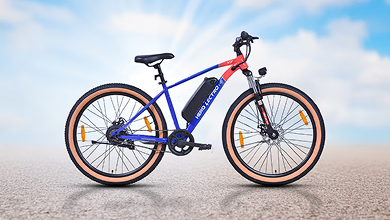
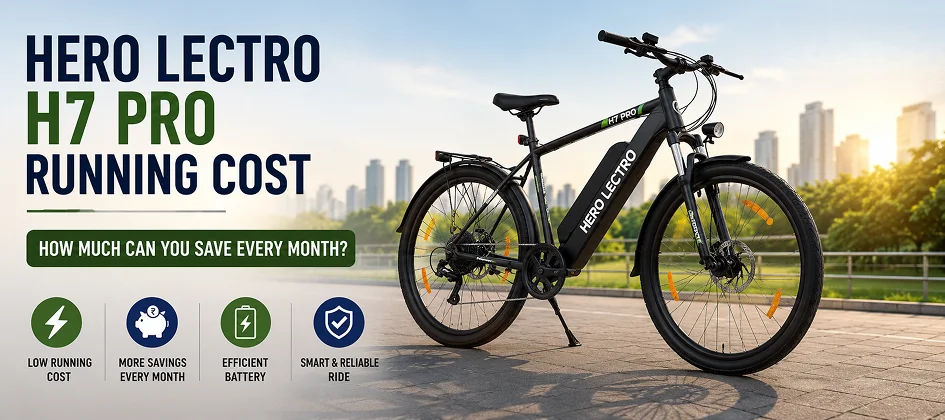
This financial burden has made electric bicycles (e-cycles) an appealing option for short-distance daily travel. The Hero Lectro H7 Pro is one of the most prominent premium urban electric cycles in India. It offers pedal-assist technology alongside a pure throttle mode to help riders travel without heavy physical exertion.
However, beyond features, style, and convenience, most buyers want to answer one financial question: What is the actual Hero Lectro H7 Pro running cost, and how much money can it save compared to a standard petrol scooter or public transport every month?
This comprehensive guide breaks down the charging expenses, cost per kilometre, monthly running costs, maintenance requirements, and potential savings of the Hero Lectro H7 Pro in real-world Indian riding conditions.
The Hero Lectro H7 Pro operates at an estimated running cost of INR 0.07 to INR 0.10 per kilometre, based on average Indian residential electricity tariffs (~INR 8.00 per kWh). Compared to a standard 110cc/125cc petrol scooter costing ~INR 2.22 per kilometre to run, a commuter riding 20 km daily can save approximately INR 1,000 to INR 1,200 per month on energy expenses alone.
Before calculating operating expenses, it is helpful to look at the core specifications of the Hero Lectro H7 Pro. The H7 Pro features an integrated battery pack within its alloy frame and a rear hub motor designed for urban commuting.
| Specification / Feature | Official / Claimed Figure | Practical / Real-World Expectation |
| Vehicle Category | Urban Electric Cycle (Pedal Assist + Throttle) | Short-distance urban commuter / fitness cycle |
| Battery Type & Location | In-tube Lithium-ion Battery Pack | Integrated internal frame battery |
| Battery Capacity | 36V, 5.8 Ah (~0.208 kWh / 208 Wh) | ~0.21 kWh capacity |
| Motor Power & Type | 250W High-Torque Rear Hub Motor | 250W BLDC Rear Hub Motor |
| Claimed Range (Pedal Assist) | Up to 30 km per full charge | 22 – 25 km (depending on rider weight & terrain) |
| Claimed Range (Pure Throttle) | Up to 25 km per full charge | 18 – 20 km (in flat city conditions) |
| Top Speed | Up to 25 km/h (Govt. restricted) | 25 km/h on flat roads |
| Charging Time | ~3 to 4 Hours (Standard AC Charger) | ~3.5 hours using home 15A/5A socket |
| Frame Material | Lightweight Aluminum Alloy (6061) | Sturdy, rust-resistant urban geometry |
| Gears / Drivetrain | 7-Speed Shimano Gear System | Helps extend range on inclines via pedalling. |
| Brakes | Dual Mechanical Disc Brakes | Reliable stopping power in dry/wet conditions |
| Wheel / Tyre Size | 27.5" x 2.10" City Tyres | Good grip on paved roads and minor potholes |
| Key Features | LED Display, Key Lock Switch, App Connectivity | Focuses on commuter utility and basic tracking |
Note: Real-world range varies depending on whether you rely solely on the throttle or combine pedalling with lower pedal-assist modes.
When assessing electric vehicle ownership, buyers sometimes confuse the upfront purchase price with ongoing operating expenses. To keep financial evaluation clear:
Total Cost of Ownership} = Initial Purchase Price + Running Cost
Purchase Price: The one-time capital cost paid to buy the cycle, charger, and initial riding accessories (helmet, lock, lights).
Running Cost: The recurring expenses required to keep the vehicle operating daily.
Electricity / Charging Cost: The energy drawn from your home electrical socket to charge the internal battery.
Routine Consumables: Minor replacement parts like brake pads, inner tubes, and brake cables over thousands of kilometres.
Drivetrain Maintenance: Periodic cleaning and lubrication of the 7-speed Shimano chain, cassette, and derailleur.
Tyre Maintenance: Air pressure maintenance and eventual tyre replacement after long usage.
Unlike petrol scooters or cars, the Hero Lectro H7 Pro does not require road tax, RTO registration fees, commercial fitness certificates, or mandatory yearly insurance in most Indian states (due to its motor output under 250W and top speed under 25 km/h).
Calculating the exact cost to charge the Hero Lectro H7 Pro requires understanding its battery size, charger conversion efficiency, and local domestic electricity tariffs.
Charging Cost (INR) = Battery Energy (kWh) x (1 + Charging Loss Margin) x Electricity Tariff (INR/kWh)
Battery Capacity: The Hero Lectro H7 Pro houses a 36V, 5.8 Ah battery pack.
Battery Energy = 36 Vx 5.8 Ah = 208.8 Watt-hours (Wh) = 0.2088 kWh (units)
Charging Efficiency & Loss Margin: Home AC-to-DC chargers incur energy losses via heat generation during power conversion. Accounting for a 15% to 20% loss margin:
Total Grid Power Consumed = 0.2088 kWh x 1.20 = 0.2505 kWh (units)
This means a full charge draws approximately 0.25 units (1/4th of a kWh unit) from your electricity meter.
Electricity Tariff Assumption: Domestic electricity rates across major urban centres in India (such as Ahmedabad, Rajkot, Mumbai, Pune, Bengaluru, and Delhi NCR) average between INR 6.50 and INR 9.50 per unit. For a clear, realistic baseline, we use an average tariff of INR 8.00 per unit (kWh) (as of mid-2026).
Cost per Full Charge = 0.25 units x INR 8.00 = INR 2.00
It costs approximately INR 2.00 to charge the Hero Lectro H7 Pro battery from 0% to 100% at home.
To determine the Hero Lectro H7 Pro cost per km, we divide the full charge cost by the distance covered on that charge.
Battery Capacity: 0.2088 kWh (~0.25 units drawn, including charger loss)
Cost Per Full Charge: INR 2.00
Electricity Tariff: INR 8.00 / kWh
Scenario A: Mixed Mode / Pedal Assist (Real-World Range: ~22 km)
Cost per KM (Pedal Assist) = INR 2.00 / 22 km = INR 0.0909 per km
Scenario B: Pure Throttle Mode (Real-World Range: ~18 km)
Cost per KM (Pure Throttle) = INR 2.00 / 18 km = INR 0.1111 per km
Taking an average across commuting styles, the energy cost for the Hero Lectro H7 Pro is approximately INR 0.08 to INR 0.10 per kilometre.
To understand how this translates into daily usage, let us look at three typical commuting distances across 25 working days per month.
Scenario 1: Short Commuter   --> 20 km / day (500 km / month)

Scenario 2: Regular Commuter --> 40 km/day (1,000 km/month)

Scenario 3: Heavy Commuter   --> 60 km / day (1,500 km / month)
Daily Distance: 20 km
Monthly Distance (25 Days): 500 km
Full Charges Required: 500 km /20 km / charge = 25 full charges
Monthly Electricity Consumed: 25 x 0.25 units = 6.25 units
Monthly Electricity Cost: 6.25 units x INR8.00 = INR 50.00
Estimated Monthly Consumables Allowance: INR 50.00 (chain lube, brake alignment)
Total Monthly Running Cost: INR 100.00
Daily Distance: 40 km (Requires mid-day top-up or dual charging)
Monthly Distance (25 Days): 1,000 km
Full Charges Required: 1,000 km /20 km/charge = 50 full charges
Monthly Electricity Consumed: 50 x 0.25 units = 12.5 units
Monthly Electricity Cost: 12.5 units x INR 8.00 = INR 100.00
Estimated Monthly Consumables Allowance: INR 75.00
Total Monthly Running Cost: INR 175.00
Daily Distance: 60 km (Requires 2 to 3 charges daily)
Monthly Distance (25 Days): 1,500 km
Full Charges Required: 1,500 km /20 km/charge = 75 full charges
Monthly Electricity Consumed: 75 x 0.25 units = 18.75 units
Monthly Electricity Cost: 18.75 units x INR 8.00 = INR 150.00
Estimated Monthly Consumables Allowance: INR 100.00
Total Monthly Running Cost: INR 250.00
To see how much an electric cycle saves, it is best compared against a popular 110cc or 125cc petrol commuter scooter (such as a Honda Activa or TVS Jupiter).
Petrol Price: INR 100.00 / Litre (Representative Indian metro benchmark)
Real-World City Mileage: 45 km / Litre
Fuel Cost per KM: INR100.0/45 km/L = INR 2.22 per km
| Cost Factor | Hero Lectro H7 Pro (Electric Cycle) | Standard Petrol Scooter (110cc/125cc) |
| Primary Fuel / Energy | Domestic Electricity | Petrol (E20 blend) |
| Unit Price | INR 8.00 / kWh (unit) | INR 100.00 / Litre |
| Energy Consumption | ~1.25 kWh per 100 km (wall draw) | ~2.22 Litres per 100 km |
| Estimated Cost per KM | ~INR 0.10 | ~INR 2.22 |
| Daily Cost (20 km/day) | INR 2.00 | INR 44.40 |
| Daily Cost (40 km/day) | INR 4.00 | INR 88.80 |
| Monthly Cost (500 km) | INR 50.00 (energy) | INR 1,110.00 (fuel) |
| Monthly Cost (1,000 km) | INR 100.00 (energy) | INR 2,220.00 (fuel) |
| Maintenance Profile | Basic cycle tuning, disc pads, chain lube | Engine oil, spark plug, air filter, CVT belt |
| Mandatory Annual Fees | INR 0 (No RTO registration / tax needed) | Insurance, pollution check (PUC), service labor |
We can calculate direct operational savings using the following formula:
Monthly Savings = Petrol Scooter Fuel Cost - Hero Lectro H7 Pro Charging Cost
| Daily Commute Distance | Petrol Cost (At INR 20.22/KM) | H7 Pro Cost (At INR 0.10/KM) | Net Monthly Fuel Savings |
| 20 km/day (500 km/Month) |
INR 1110.00 | INR 50.00 | INR 10600.00 |
| 40 km/day (1,000 km/Month) | INR 2220.00 | INR 100.00 | INR 2120.00 |
| 60 km/day (1,500 km/Month) | INR 3330.00 | INR 150.00 | INR 3180.00 |
Note: Actual savings vary depending on whether you pedal regularly, local electricity rates, state petrol prices, and terrain.
Scaling these figures across 12 operational months illustrates how annual fuel savings accumulate for a regular commuter.
Annual Savings = Monthly Savings x 12 Months
Light Commuter (20 km/day = 6,000 km/year):
Petrol Scooter Fuel Bill: INR 13,320
Hero Lectro H7 Pro Electricity Bill: INR 600
Potential Annual Energy Savings: ~INR 12,720
Regular Commuter (40 km/day = 12,000 km/year):
Petrol Scooter Fuel Bill: INR 26,640
Hero Lectro H7 Pro Electricity Bill: INR 1,200
Potential Annual Energy Savings: ~INR 25,440
Heavy Commuter (60 km/day = 18,000 km/year):
Petrol Scooter Fuel Bill: INR 39,960
Hero Lectro H7 Pro Electricity Bill: INR 1,800
Potential Annual Energy Savings: ~INR 38,160
These figures cover energy costs. When you factor in the saved expenses on petrol scooter servicing (engine oil changes, air filter swaps, and transmission tuning), total annual savings increase further.
Comparing maintenance needs between an electric bicycle and an ICE vehicle shows significant structural differences.
No Engine or Transmission Servicing: Zero expenditure on engine oil, oil filters, spark plugs, carburettor/FI cleaning, or CVT drive belts.
Mechanical Drivetrain Maintenance: The 7-speed Shimano gear system requires periodic chain degreasing, lamination, and derailleur indexing every 500–800 km (costing around INR 100–INR 200 per lube session if done at home or a local cycle shop).
Brake Servicing: Dual mechanical disc brakes wear over time. Disc pads need adjustment or replacement every 3,000–5,000 km (costing ~INR 250–INR 400 per pair).
Tyres & Tubes: Standard 27.5-inch city tyres need regular air pressure checks. Tube punctures can be fixed at any local bicycle repair shop for ~INR 30–INR 50.
Estimated Routine Annual Service Cost: INR 600 to INR 1,200 annually (primarily brake pads, chain lubricant, and cable adjustments).
Periodic engine oil and oil filter replacement every 3,000 km.
CVT belt and clutch cleaning every 8,000 km.
Air filter and spark plug replacement every 6,000–10,000 km.
Mandatory RTO registration, road taxes, PUC certificates, and third-party insurance.
Estimated Routine Annual Service Cost: INR 2,500 to INR 4,500 annually.
While baseline calculations offer clear benchmarks, actual per-kilometre expenses depend on several practical variables:
Level of Pedaling: Utilizing low pedal-assist modes extends battery range beyond 25 km, lowering the effective cost per km. Relying solely on pure throttle increases energy draw.
Rider Weight & Cargo: Heavier loads place higher torque demands on the 250W rear hub motor, reducing distance per charge.
Terrain & Road Conditions: Riding on hilly inclines or rough, unpaved surfaces uses battery energy faster than smooth, flat city tarmac.
Tyre Inflation: Under-inflated 27.5-inch tyres increase rolling resistance, reducing total range by up to 10–15%.
Chain & Gear Care: A dry or rusty chain creates mechanical drag, requiring more motor assistance and battery energy.
Electricity Tariff Slabs: Charging during higher domestic tier slabs impacts the final cost per unit.
The Hero Lectro H7 Pro serves specific commuting profiles effectively. Understanding its strengths helps determine if it fits your travel needs.
Short Office / Work Commutes (5–12 km each way): Allows you to arrive at work without heavy fatigue while avoiding petrol expenses and urban traffic delays.
College & Campus Travel: Provides convenient transportation around university towns and metro feeder routes.
Local Errands & Grocery Runs: Quick travel to nearby markets without starting a motor vehicle.
Fitness Commuting: Option to pedal for morning exercise, then switch to electric throttle mode on the way home.
If your daily single-trip distance exceeds 20–25 km without opportunities to recharge at your destination.
If you frequently travel with a heavy pillion passenger.
If you must regularly travel on high-speed arterial highways or motorways with traffic moving above 50 km/h.
To explore other options, check our guides on electric cycle comparisons, electric scooters, and broader EV running costs.
Financial return on an electric bicycle depends on daily mileage and your current mode of transport.
Daily Distance |
Target User |
Financial Impact / Assessment |
10 – 15 km/day |
Short Commuter/Local Errands | Replaces public transport auto fares (~INR 600–INR 800/mo). |
20 – 30 km/day |
Daily Office / College Commuter | Ideal sweet spot. Saves ~INR 1,000–INR 1,500/mo vs petrol. |
35+ km/day |
High-Distance Commuter | Maximises fuel savings but requires midday recharging. |
Commuters Replacing Auto-Rickshaws & Cabs: If you spend INR 100 to INR 150 daily on shared auto-rickshaws or cab rides for short routes, switching to the H7 Pro can save INR 2,000 to INR 3,000 per month.
Scooter Owners Travelling 15–25 km Daily: Replacing daily short scooter trips with the H7 Pro can save INR1,000 to INR1,400 monthly in petrol costs while reducing wear on your primary vehicle.
Extremely Low Energy Cost: Costs roughly INR 0.08 to INR 0.10 per km to run.
Simple Household Charging: Charges using a standard 5A home socket in 3 to 4 hours.
No Paperwork Overhead: No RTO registration, driving licence requirements, road tax, or mandatory yearly insurance needed in most Indian states.
Zero Tailpipe Emissions: Eco-friendly urban transport.
Health Benefits: Provides flexible exercise options via pedal-assist modes.
Fixed Range Capacity: Real-world range is limited to ~20–25 km per charge, requiring planning for longer trips.
Speed Restrictions: Top speed is restricted to 25 km/h by law.
Weather Exposure: Offers no weather protection during monsoons or peak summer heat.
Pillion Limitations: Designed primarily for single riders without heavy passenger capabilities.
Evaluating whether the Hero Lectro H7 Pro is worth buying comes down to matching its specifications with your daily routine:
For Commuters Travelling Under 20 km Daily: Highly Recommended. The combination of low energy expenses (~INR 50–INR100/month), zero RTO fees, and light maintenance makes it an economical choice for urban travel.
For Fitness-Minded Commuters: Recommended. You can pedal to maintain fitness and use motor assistance when going uphill or when tired.
For Long-Distance / Highway Riders: Consider Alternatives. If you travel more than 35 km daily on high-speed roads, an electric scooter with a larger battery and higher top speed may better suit your needs.
For more details on electric choices, review our guides on electric bicycle monthly running costs in India and our curated electric vehicle buying guides.
The financial breakdown shows clear operational savings: The Hero Lectro H7 Pro can save a daily commuter between INR 1,000 and INR 2,100 every month on energy costs alone when replacing a standard petrol scooter for short city trips.
Best For: Short-distance urban commuters, college students, local errand runners, and fitness enthusiasts travelling 10 to 20 km daily.
Key Financial Benefit: Reduces per-kilometre energy expenses from ~INR 2.22 (petrol) to ~INR 0.10 (electric) while eliminating engine maintenance and RTO registration costs.
For urban riders looking to lower monthly travel expenses, the Hero Lectro H7 Pro offers an efficient, low-cost solution for short-distance daily commuting.


Manage reminders, payment status, and renewal dates from one simple app.


Trusted by policyholders to track every renewal.