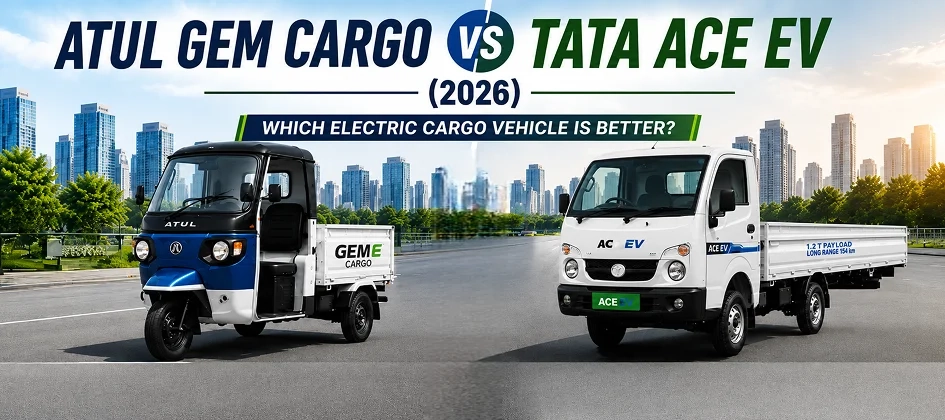
The commercial transportation landscape in India is undergoing a rapid, structural transformation. Driven by soaring diesel prices, aggressive government green mobility mandates, and the undeniable financial advantages of electric drivetrains, commercial fleet owners and small business proprietors are shifting en masse toward electric commercial vehicles (EVs). Last-mile delivery, local logistics, e-commerce dispatch, and neighbourhood supply networks are leading this charge.
When business owners decide to transition away from traditional internal combustion engine loaders, they face a primary choice between two distinct vehicle configurations: a three-wheeler electric cargo loader like the Atul GEM Cargo or a four-wheeler electric mini truck like the Tata Ace EV.
Both vehicles have earned strong reputations in their respective vehicle classes, but they serve fundamentally different operational scales, payload requirements, and budget constraints. This detailed comparison examines prices, payload capabilities, battery technology, driving ranges, charging times, running costs, and business applications to help you determine which electric cargo vehicle offers the best return on investment for your enterprise.
To understand how these two vehicles compare, let's examine their technical specifications side by side.
| Specification / Feature | Atul GEM Cargo | Tata Ace EV |
| Vehicle Category | Electric Cargo Three-Wheeler (L5N) | Electric Cargo Mini Truck (Four-Wheeler) |
| Ex-Showroom Price | INR 2.45 Lakh – 2.95 Lakh | INR 6.50 Lakh – 11.50 Lakh |
| Certified Driving Range | ~80 km – 90 km per charge | ~154 km – 161 km per charge |
| Real-World Range (Loaded) | ~65 km – 75 km | ~100 km – 120 km |
| Rated Payload Capacity | 480 kg – 575 kg | 600 kg – 1,000 kg |
| Gross Vehicle Weight (GVW) | 995 kg – 1,020 kg | 1,610 kg – 2,120 kg |
| Battery Type | Lithium-ion Battery Pack | Lithium Iron Phosphate (LFP) |
| Battery Capacity | ~8 kWh – 10 kWh | 14.4 kWh – 21.3 kWh |
| Charging Time (Standard) | 4 – 5 Hours (15A AC Socket) | 5 – 6 Hours (Standard AC) |
| Fast Charging Support | Not Available | Yes (~105 Minutes to 100%) |
| Top Speed | 25 – 45 km/h | 50 – 60 km/h |
| Suspension (Front/Rear) | Telescopic Hydraulic / Leaf Spring | Parabolic Leaf / Semi-Elliptical Leaf |
| Target Audience | Small retailers, local vendors, micro-deliveries | 3PL logistics, FMCG distributors, large fleets |
Initial acquisition cost is frequently the decisive factor for small business owners and commercial fleet operators when purchasing a new vehicle.
The Atul GEM Cargo is designed as a budget-friendly electric three-wheeler. With ex-showroom prices starting between INR 2.45 lakh and INR 2.95 lakh, it offers a low barrier to entry. For individual owner-operators, retail shopkeepers, and local service providers, this manageable purchase price keeps upfront down payments low and results in minimal monthly EMI obligations. The lower capital expenditure allows smaller businesses to achieve profitability and break-even status much faster.
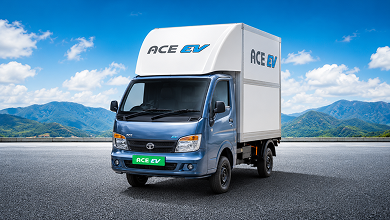
The Tata Ace EV sits in the premium electric mini truck category. The entry-level Tata Ace Pro EV starts around INR 6.50 lakh, while higher-capacity models like the Tata Ace EV 1000 can reach up to INR 11.50 lakh. Although the initial investment is significantly higher, it provides buyers with a four-wheel commercial chassis, higher load capacities, double the volumetric cargo space, and advanced vehicle tracking systems suitable for multi-vehicle commercial fleets.
Key Takeaway: If your primary objective is minimising upfront investment and reducing monthly financial risk, the Atul GEM Cargo provides an accessible entry point. If you have the capital or financing power to invest in higher cargo volumes, the Tata Ace EV delivers long-term scalability.
Payload limits and cargo volume directly govern how much earning potential a vehicle generates per trip.
| Application Sector | Atul GEM Cargo Suitability | Tata Ace EV Suitability |
| Grocery & Dairy Delivery | Ideal for hyper-local retail drops | Preferred for wholesale bulk crates |
| E-Commerce Logistics | Perfect for neighborhood last-mile drops | Best for hub-to-hub hub-and-spoke distribution |
| Gas Cylinders & Hardware | Suitable for light local routes (up to 500 kg) | Excellent for heavy industrial goods (up to 1,000 kg) |
| Pharmacy & Bakeries | High efficiency for frequent stop-and-go | Excess capacity for small parcel needs |
| FMCG & Warehouse Transit | Limited cargo tray volume | High container volume for stacked boxes |
Atul GEM Cargo: Certified to carry between 480 kg and 575 kg depending on the tray build and body configuration. Its three-wheel layout gives it a tight turning radius (~2.5 metres), allowing drivers to easily manoeuvre through dense urban markets, narrow residential corridors, and crowded traffic spots where larger four-wheel trucks frequently get stuck.
Tata Ace EV: Built to haul heavy cargo loads ranging from 600 kg to 1,000 kg. Supported by heavy-duty leaf spring suspension, rigid axles, and a large loading deck measuring over 7 feet in length, the Ace EV excels at carrying dense, bulky items. Its four-wheel stability makes it far safer and more steady when cruising along city ring roads, elevated flyovers, and suburban highways with a full load.
Vehicle downtime translates directly to lost revenue in commercial transportation. Assessing battery management, real-world operational range, and charging logistics is critical before purchasing.
Vehicle Range Comparison (Certified vs. Loaded Real-World)
Atul GEM Cargo:
Certified Range: 90 km
Real-World Range: 75 km
Tata Ace EV:
Certified Range: 161 km
Real-World Range: 120 km
Atul GEM Cargo: Utilises a standard lithium-ion battery pack engineered for light commercial cycles. It delivers a certified range of 80 km to 90 km, which translates to a real-world loaded range of around 65 km to 75 km. For hyper-local routes within a 10 to 15 km radius, this range easily satisfies a standard workday without needing mid-shift charging breaks.
Tata Ace EV: Features an advanced Lithium Iron Phosphate (LFP) battery chemistry (14.4 kWh on the Pro EV, up to 21.3 kWh on the standard Ace EV). LFP batteries are recognised for high thermal stability, long cycle life, and resistance to degradation in warm climates. It delivers a certified range of 154 km to 161 km, with a real-world loaded performance of 100 km to 120 km, making it capable of executing multi-hub regional trips.
Atul GEM Cargo: Charges fully in approximately 4 to 5 hours via a standard 15A AC electrical socket. It requires no specialised high-power infrastructure, allowing drivers to recharge overnight at a home, shop, or local garage.
Tata Ace EV: Offers dual charging options. It can be charged using a standard 15A AC plug in about 6 hours or topped up via DC fast chargers in just 105 minutes. Fast-charging capability enables logistics operators to implement double-shift operations by fast-charging during lunch breaks or driver shifts.
Switching from diesel to electric commercial vehicles yields dramatic operational cost savings.
| Expense Category | Conventional Diesel Loader | Atul GEM Cargo (EV) | Tata Ace EV |
| Energy / Fuel Cost per KM | INR 4.50 – INR 6.50 / km | INR 0.40 – INR 0.70 / km | INR 0.80 – INR 1.20 / km |
| Scheduled Oil & Filter Changes | Every 5,000 – 10,000 km | None Required | None Required |
| Transmission & Clutch Repairs | Frequent clutch wear | Minimal | Minimal (Direct Drive) |
| Brake Wear Expense | High brake pad wear | Low (Regenerative Braking) | Low (Regenerative Braking) |
| Estimated Yearly Fuel Savings | Baseline | INR 90,000 – INR 120,000 | INR 1,10,000 – INR 1,50,000 |
Electric drivetrains eliminate hundreds of moving mechanical parts found in internal combustion engines. There are no engine oils, spark plugs, fuel filters, exhaust silencers, or clutch plates to replace.
The Atul GEM Cargo costs as little as 40 to 70 paise per kilometre in electricity, making it one of the most economical transport vehicles on Indian roads. The Tata Ace EV runs at roughly 80 paise to INR 1.20 per kilometre, which still yields massive operational savings over traditional diesel mini trucks that cost between ₹5.00 and INR 7.00 per kilometre.
Furthermore, Tata Motors provides an extensive battery warranty (up to 6 years or 160,000 km depending on the variant), protecting fleet operators from premature battery replacement costs.
Driver comfort and vehicle intelligence play a vital role in driver retention and operational safety.
Atul GEM Cargo: Utilises an open or semi-enclosed handlebar-steered cab arrangement. It is designed for straightforward operation, allowing drivers to quickly hop on and off during frequent neighbourhood package deliveries. Dashboard controls are straightforward and minimalist, keeping overall vehicle complexity low.
Tata Ace EV: Delivers a complete automotive cabin experience featuring steering wheel controls, bucket seating for two (D+1 configuration), a digital instrument cluster, power steering on select variants, and regenerative braking. Crucially, the Tata Ace EV includes Tata's Fleet Edge telematics platform, which provides fleet managers with real-world insights, including the following:
Live GPS tracking and geofencing
Real-time battery state of charge (SoC) monitoring
Driver behavior analysis (harsh braking, over-speeding)
Remote vehicle health diagnostics and scheduled service alerts
Selecting the right commercial EV depends on your business scale, route length, and load requirements.
| Operational Profile | Recommended Vehicle | Primary Rationale |
| Small Retailer / Local Vendor | Atul GEM Cargo | Very low purchase price, rapid return on investment, simple 15A home socket charging. |
| Hyper-Local Delivery (< 60 km/day) | Atul GEM Cargo | Operating cost of under ₹0.70/km with sufficient battery capacity for short daily loops. |
| Narrow Market & Alley Operations | Atul GEM Cargo | Superior manoeuvrability and a small turning radius for tight city streets. |
| Logistics Fleet & 3PL Operators | Tata Ace EV | Telematics connectivity, high vehicle durability, and fast-charging support. |
| Heavy Payload Deliveries (600 kg – 1,000 kg) | Tata Ace EV | Four-wheel stability, leaf spring suspension, and double the cargo tray volume. |
| Multi-Shift / Inter-City Transit | Tata Ace EV | 150+ km certified range paired with DC fast-charging for quick turnarounds. |
Both the Atul GEM Cargo and the Tata Ace EV are top performers in the Indian electric commercial vehicle market, but they target different business needs:
Choose the Atul GEM Cargo if you are an independent operator, small business owner, or local merchant seeking a budget-friendly, highly manoeuvrable 3-wheeler for short-distance, light-to-medium urban deliveries.
Choose the Tata Ace EV if you manage a logistics fleet, require higher load capacity (up to 1,000 kg), cover longer daily city routes, and need DC fast-charging capabilities along with telematics fleet tracking.



Manage reminders, payment status, and renewal dates from one simple app.


Trusted by policyholders to track every renewal.