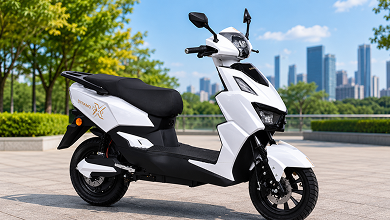
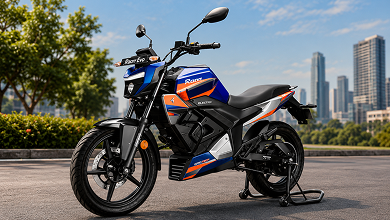
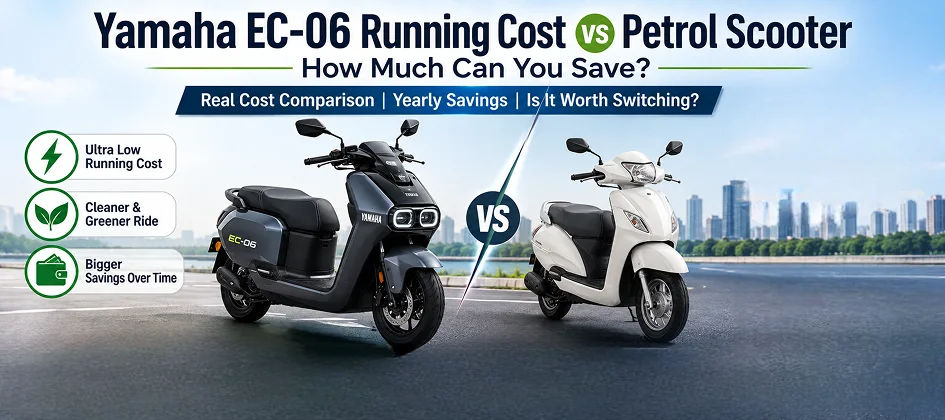
With fuel prices hovering around ₹100 per litre in India, daily commuters are paying close attention to their monthly transport expenses. Electric two-wheelers have transitioned from niche eco-friendly experiments into practical alternatives for everyday urban travel. Among the latest high-profile entrants in the Indian market is the Yamaha EC-06, an electric scooter developed in collaboration with Indian EV maker River.
While design, smart features, and brand legacy drive initial interest, the decision to switch from a conventional 110cc or 125cc petrol scooter to an electric model almost always comes down to finance. Buyers want to know: What is the actual Yamaha EC-06 running cost, and how much money can it save over a standard petrol scooter?
This comprehensive guide breaks down the charging cost, per-kilometre operating expenses, maintenance requirements, and long-term ownership dynamics of the Yamaha EC-06 compared to standard petrol scooters in real-world Indian riding conditions.
Yes, the Yamaha EC-06 can significantly lower your daily running expenses. Based on average Indian residential electricity tariffs (~INR 8 per kWh) and current petrol prices (~INR 100 per litre), the Yamaha EC-06 costs roughly INR 0.35 to INR 0.40 per km to run, compared to INR 2.10 to INR 2.35 per km for a typical 125cc petrol scooter. For a commuter riding 40 km per day, this translates to potential fuel savings of over INR 22,000 to INR 25,000 annually.
Before calculating running costs, it is essential to examine the technical foundations of the Yamaha EC-06. Built on a proven high-rigidity chassis with 14-inch alloy wheels, the EC-06 combines urban agility with robust load capacity.
| Specification / Feature | Official / Claimed Figure | Real-World / Practical Expectation |
| Vehicle Type | Premium Urban Electric Scooter | High-speed urban commuter |
| Battery Capacity | 4.0 kWh (Lithium-ion / NMC) | 4.0 kWh fixed pack |
| Motor Type & Power | Mid-Mounted IPMSM (6.7 kW peak) | 6.7 kW peak power / 26 Nm torque |
| Drive Type | Chain Drive | Chain drive (requires periodic lubrication) |
| Claimed Range (IDC) | 169 km per full charge | 110 – 115 km (Eco/Standard mode in city traffic) |
| Top Speed | 79 km/h (electronically limited) | ~79 – 85 km/h depending on mode and load |
| Charging Time | 0–100% in 10 Hours (Standard AC) | ~10 hours at home via standard 15A socket |
| Storage & Utility | 24.5 L Under-seat storage | Fits a standard helmet and portable charger |
| Key Features | LCD Instrument Cluster, Riding Modes (Eco/STD/PWR), Telescopic Suspension, Dual Disc Brakes | Focuses on chassis stability, seating space, and practical urban comfort |
Understanding the difference between the IDC claimed range (169 km) and the real-world city range (~110 km) is vital for accurate financial planning, as real-world energy consumption determines your actual electricity bill.
When evaluating EV running costs, buyers often confuse initial purchase price with operational expenses. To keep financial comparisons clear, 'running cost' refers strictly to the day-to-day money required to keep the vehicle moving on the road.
Fuel / Energy Costs: The money spent on petrol for an ICE scooter or on electricity for EV charging.
Routine Maintenance: Consumables like engine oil, spark plugs, and air filters for petrol engines, or gearbox oil and chain lube for electric scooters.
Wear-and-Tear Items: Periodic replacement of brake pads, tyres, belts, and cables over thousands of kilometres.
Periodic Inspection: Standard service charges, brake adjustments, and software diagnostics.
Note: Ex-showroom price, state registration taxes, mandatory insurance, and loan financing EMIs represent upfront capital expenditure and ownership financing; they are separate from daily running costs.
Calculating the exact cost to charge an electric scooter requires understanding battery capacity, charger efficiency, and local electricity tariffs.
Charging Cost (₹) = Battery Capacity (kWh) × (1 + Charging Loss Margin) X Electricity Tariff (₹/kWh)
Nominal Battery Capacity: The Yamaha EC-06 houses a 4.0 kWh lithium-ion battery pack.
Charging Efficiency & Losses: No battery charger transfers energy at 100% efficiency. Heat generation, AC-to-DC conversion, and battery management system (BMS) power draw typically result in a 15% to 20% charging loss.
Actual electricity drawn from wall socket: 4.0 kWh X 1.20 = 4.8 kWh (units)
Electricity Tariff Assumption: Residential electricity slabs in urban Indian cities (such as Delhi, Bengaluru, Mumbai, or Ahmedabad) average between INR 7.00 and INR 9.00 per unit (kWh). For our calculations, we will use a standardised average tariff of INR 8.00 per kWh.
Total Full Charge Cost = 4.8 units X INR 8.00 = INR 38.40
It costs approximately INR 38.40 to fully charge the Yamaha EC-06 from 0% to 100% at home.
To derive the cost per kilometre, we divide the full charge cost by the distance the scooter can travel on that single charge.
Full-Charge Electricity Consumption: 4.8 kWh (including losses)
Electricity Rate: INR 8.00 / kWh
Total Full Charge Cost: INR 38.40
Real-World City Range: 110 km (Mix of Eco and Standard modes in typical urban traffic)
Yamaha EC-06 Cost Per KM = INR 38.4 / 110 km = INR 0.349 per km (INR 0.35 / km)
If you ride more aggressively in 'power' mode or carry heavy pillion loads, real-world range may settle closer to 95 km, adjusting the per-km cost.
Conservative Cost Per KM (Power Mode) = INR 38.40 / 95 km = INR 0.404 per km (INR 0.40 km)
Therefore, the estimated energy cost per kilometre for the Yamaha EC-06 lies between INR 0.35 and INR 0.40.
To make a fair comparison, we must pit the Yamaha EC-06 against a comparable, modern 125cc petrol commuter scooter (such as the Honda Activa 125, TVS Jupiter 125, or Suzuki Access 125).
Average Petrol Price: INR 100.00 per litre (representative Indian metro pricing).
Real-World City Fuel Mileage: 45 km per litre (under realistic stop-and-go city traffic conditions).
Petrol Scooter Cost Per KM = INR 100.00 / 45 km / l = INR 2.22 per km
Under heavy city traffic or sportier riding conditions, mileage may drop to 40 km/L, raising fuel costs to INR 2.50 per km. Conversely, gentle riding on open roads might yield 50 km/L, lowering costs to INR 2.00 per km. A baseline figure of INR 2.22 per km represents typical Indian urban commuting.
Here is how the energy and fuel costs compare side-by-side:
| Cost Factor | Yamaha EC-06 (EV) | Standard 125cc Petrol Scooter |
| Primary Energy Source | Residential Electricity | Unlead Petrol (E20 blend) |
| Unit Energy Cost | INR 8.00 / kWh | INR 100.00 / Litre |
| Energy Consumption Rate | ~4.36 kWh per 100 km (wall socket draw) | ~2.22 Litres per 100 km |
| Approx. Cost per KM | INR 0.35 | INR 2.22 |
| Daily Cost (30 km/day) | INR 10.50 | INR 66.60 |
| Daily Cost (50 km/day) | INR 17.50 | INR 111.00 |
| Monthly Cost (1,000 km) | INR 350.00 | INR 2,220.00 |
| Annual Cost (12,000 km) | INR 4,200.00 | INR 26,640.00 |
Note: Calculations assume 110 km real-world range for the EC-06 and 45 km/L real-world mileage for the petrol scooter.
Every rider's commuting distance differs. The table below outlines monthly energy/fuel costs across three common commuting profiles, assuming 25 operational days per month.
Scenario A: Short Commute (20 km/day)  --> 500 km / month

Scenario B: Medium Commute (40 km/day) --> 1,000 km / month

Scenario C: Long Commute (60 km/day)   --> 1,500 km / month
1. Low Usage: 20 km/day = 500 km/month
Yamaha EC-06: 500 km × INR 0.35 km = INR 175.00
Petrol Scooter: 500 km × INR 2.22/km = INR 1,110.00
Monthly Energy Difference: INR 935.00
2. Moderate Usage: 40 km/day = 1,000 km/month
Yamaha EC-06: 1,000 km × INR 0.35 km = INR 350.00
Petrol Scooter: 1,000 km × INR 2.22 km = INR 2,220.00
Monthly Energy Difference: INR 1,870.00
3. Heavy Usage: 60 km/day = 1,500 km/month
Yamaha EC-06: 1,500 km × INR 0.35 km = INR 525.00
Petrol Scooter: 1,500 km × INR 2.22 km = INR 3,330.00
Monthly Energy Difference: INR 2,805.00
By scaling up the monthly energy calculations over a full year (12 months), we can observe how potential savings accumulate based on annual riding distance.
Annual Distance = Monthly Distance x 12 Months
At 6,000 km/year (20 km/day):
Yamaha EC-06 Electricity Cost: INR 2,100
Petrol Scooter Fuel Cost: INR 13,320
Potential Annual Energy Savings: INR 11,220
At 12,000 km/year (40 km/day):
Yamaha EC-06 Electricity Cost: INR 4,200
Petrol Scooter Fuel Cost: INR 26,640
Potential Annual Energy Savings: INR 22,440
At 18,000 km/year (60 km/day):
Yamaha EC-06 Electricity Cost: INR 6,300
Petrol Scooter Fuel Cost: INR 39,960
Potential Annual Energy Savings: INR 33,660
Important Note: Actual savings vary based on individual riding style, exact electricity tariffs in your state, local petrol prices, passenger weight, tyre pressure maintenance, and ambient climate. These figures reflect operating energy differentials and do not guarantee fixed overall savings across all ownership models.
Beyond direct fuel and energy consumption, routine maintenance plays a critical role in long-term vehicle expenditure. The mechanical complexity of internal combustion engines (ICE) differs significantly from the streamlined powertrain of electric scooters.
A petrol scooter contains hundreds of moving parts subject to heat, friction, and combustion residue. Regular scheduled servicing is necessary to prevent internal wear.
Engine Oil & Oil Filter Changes: Required every 3,000 to 4,000 km.
Air Filter Replacement: Required every 6,000 to 10,000 km.
Spark Plug Replacement: Required every 10,000 to 12,000 km.
CVT Transmission Care: Drive belt, rollers, and clutch shoe adjustments/cleaning every 8,000 km.
Valves & Carburettor/FI Cleaning: Periodic tuning and carbon cleanouts.
Exhaust System: Heat shield, rust prevention, and gasket checks.
Estimated Routine Servicing Cost: INR 1,800 to INR 3,000 annually (excluding major repairs).
Electric vehicles eliminate the engine, gearbox, fuel pump, exhaust system, and CVT assembly. However, the Yamaha EC-06 still features mechanical components that require routine inspection.
No Engine Oil or Spark Plugs: Zero expenditure on oil flushes, filters, or ignition tuning.
Final Drive (Chain Maintenance): Unlike hub-motor EVs or belt-driven models, the Yamaha EC-06 uses a traditional chain drive setup. This requires periodic clean-and-lube cycles every 500–800 km, along with occasional tension adjustments.
Brake Components: Features front and rear disc brakes. Disc pads require replacement as they wear down (regenerative braking helps extend brake pad life).
Tyres & Suspension: 14-inch wheels require regular air pressure checks and wheel alignment/balancing checks during service intervals.
Cooling & Electronics: Visual checks of wiring harnesses, battery connectors, and software updates.
Estimated Routine Servicing Cost: INR 800 to INR 1,500 annually (primarily chain maintenance, brake pads, and general inspection).
To help prospective buyers evaluate total operating expenditure over a standard 3-year ownership cycle, the table below aggregates estimated running costs for a total distance of 36,000 km (12,000 km/year).
| Expense Category | Yamaha EC-06 (3 Years / 36,000 km) | Petrol 125cc Scooter (3 Years / 36,000 km) |
| Fuel / Electricity | ~INR 12,600 (at ₹8/unit, 110 km range) | ~INR 80,000 (at ₹100/L, 45 km/L) |
| Routine Service & Lube | ~INR 3,500 (chain lube, service inspection) | ~INR 8,500 (oil changes, filters, spark plugs) |
| Wear-and-Tear Consumables | ~INR 6,000 (brake pads, chain adjustment) | ~INR 7,500 (CVT belt, rollers, brake shoes) |
| Tyre Replacement (1 Set) | ~INR 4,500 (14-inch premium scooter tyres) | ~INR 3,500 (10/12-inch standard tyres) |
| Total Operating Cost | ~INR 26,600 | ~INR 99,500 |
| Estimated Net Running Savings | ~INR 72,900 over 3 Years | — |
Disclaimer: Excludes initial vehicle purchase price, finance charges, state registration, and mandatory insurance. Battery replacement is not factored in as a guaranteed 3-year expense, as the battery is covered under standard manufacturer warranty policies (typically 3 years or 30,000–50,000 km).
While our baseline calculations use standard averages, your actual per-kilometre running cost will vary depending on several real-world operational factors:
Riding Mode Selection: Riding continuously in 'PWR' (Power) mode sharpens throttle response and unlocks higher top speeds, but it draws significantly more current, reducing range to ~80–90 km and slightly raising per-km cost.
Traffic Density: Frequent stop-and-go acceleration in heavy Indian city traffic consumes more energy than steady cruising at 35–45 km/h.
Rider and Payload Weight: Carrying a pillion rider or heavy cargo places an additional load on the 6.7 kW motor, increasing watt-hour consumption per kilometre.
Tyre Pressure: Low pressure in the 14-inch tubeless tyres increases rolling resistance, dropping overall battery range by up to 8–10%.
Chain Maintenance: Because the EC-06 uses a chain drive system, a dry, dirty, or improperly tensioned chain introduces mechanical friction, reducing efficiency.
Ambient Temperature: Extreme heat during Indian summers can increase battery thermal management overhead, slightly impacting charging efficiency.
Electricity Tariff Slabs: Charging during higher commercial rate tiers or exceeding residential consumption slabs (e.g., above 300/500 units in certain states) can raise electricity costs per kWh.
Choosing between the Yamaha EC-06 and a petrol scooter depends on your daily routines, commuting environment, and home setup.
For city-based professionals travelling 30 to 50 km daily, the Yamaha EC-06 offers distinct advantages:
Zero Tailpipe Emissions: Eco-friendly transit through congested city centres.
Quiet & Smooth Ride: Minimal mechanical vibration reduces commuting fatigue in bumper-to-bumper traffic.
Large 14-Inch Wheels: Larger wheels provide superior roll-over capability over potholes, speed breakers, and uneven Indian roads compared to standard 10-inch or 12-inch petrol scooter wheels.
If you live in an apartment with dedicated parking and a 15A power socket, or in an independent house, charging the EC-06 overnight is straightforward. Plugging the scooter in at night provides a full ~110 km real-world range every morning, eliminating weekly trips to petrol pumps.
If you frequently embark on spontaneous inter-city trips exceeding 150 km, live in a rental property without access to ground-floor charging points, or operate in regions with frequent power outages, a conventional petrol scooter offers instant refuelling flexibility.
Financial return on an electric scooter increases with usage. The more kilometres you ride, the faster the energy cost savings offset the higher initial purchase price.
Riders Travelling 10–20 km/day: Financial savings exist (~INR 900/month), but it will take longer to recoup the initial price difference over a basic petrol scooter. The choice here is often driven by ride quality and low maintenance rather than purely financial returns.
Riders Travelling 30–50 km/day: The ideal adoption zone. With monthly fuel savings reaching INR 1,800 to INR 2,500, the scooter pays back its upfront premium within 2.5 to 3 years of daily commuting.
Riders travelling 50+ km/day: Highly beneficial financially. Commuters covering 60 km daily can save over INR 33,000 per year on fuel alone. However, riders in this category must manage their daily charging routine to ensure the ~110 km range comfortably covers their demands without midday top-ups.
For more detailed comparisons on electric options, consult our comprehensive electric scooter vs petrol scooter guide and our curated electric scooter buying guides.
Low Energy Costs: Operates at roughly INR 0.35 – INR 0.40 per km, compared to INR 2.20+ per km for petrol.
Home Charging Practicality: Plug into any standard 15A household socket overnight.
Reduced Powertrain Maintenance: No engine oil, air filters, spark plugs, or exhaust maintenance.
Superior Ride Stability: 14-inch alloy wheels offer improved stability on rough city roads.
Linear Power Delivery: A 6.7 kW peak motor provides quick, vibration-free acceleration.
Upfront Cost: Higher initial ex-showroom price compared to entry-level 110cc/125cc petrol scooters.
Charging Time: Requires approximately 10 hours for a full 0–100% home charge.
Chain Maintenance: The chain drive system requires regular lubrication and tensioning, unlike belt-drive or hub-motor EVs.
Fixed Range Boundary: Real-world range (~110 km) requires planning for long, unscheduled trips.
The financial comparison shows a clear result: The Yamaha EC-06 is dramatically cheaper to operate on a daily basis than any comparable petrol scooter.
With an estimated energy cost of ~INR 0.35 per kilometre versus ~INR 2.22 per kilometre for petrol, riding the Yamaha EC-06 reduces your energy bill by roughly 80% to 85%. Over a typical 3-year ownership cycle covering 36,000 km, a commuter can accumulate over INR 70,000 in direct fuel and servicing savings.
Check Your Daily Route: If your daily travel falls between 30 km and 80 km, the EC-06 fits comfortably within its real-world single-charge limit without range anxiety.
Verify Charging Access: Ensure you have access to a reliable 15A socket at your home or workplace parking spot.
Factor in Upfront Pricing: Use your estimated annual fuel savings (e.g., ~INR 22,000/year for a 40 km daily ride) to determine how quickly the operational savings will offset the initial purchase price difference in your city.
For city riders seeking a comfortable, brand-bac


Manage reminders, payment status, and renewal dates from one simple app.


Trusted by policyholders to track every renewal.