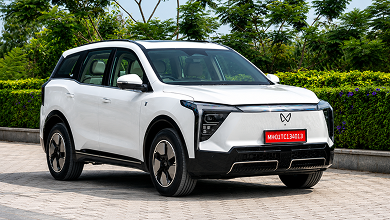
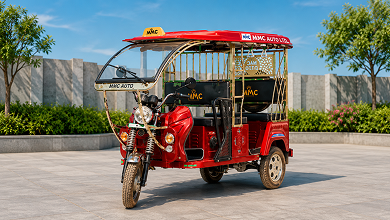
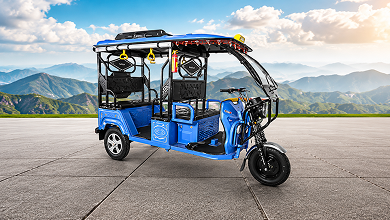
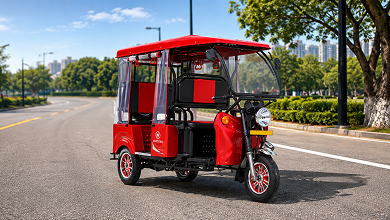
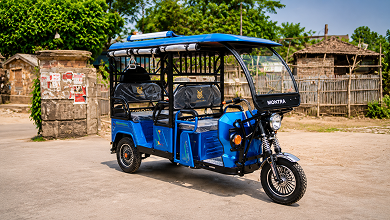
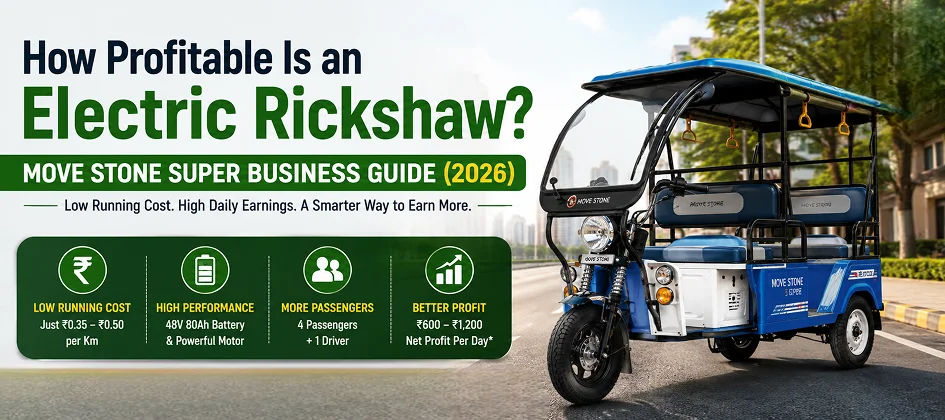
The passenger transportation sector in India is undergoing a massive transformation. From bustling metro hubs in Delhi NCR, Mumbai, and Ahmedabad to tier-2 and tier-3 towns across Uttar Pradesh, Bihar, Rajasthan, and Gujarat, three-wheeler mobility is shifting toward electric powertrains. For independent operators and fleet owners, launching an electric rickshaw business presents an opportunity to capture daily passenger demand while keeping running expenses low.
When evaluating an e-rickshaw for passenger transit, success depends heavily on operational efficiency, battery performance, and daily revenue generation. This guide explores the Move Stone Super electric rickshaw, examining initial investment costs, daily charging expenses, maintenance requirements, and overall business profit potential to assist prospective operators in making an informed decision.
Yes, an electric rickshaw business can be profitable in India when operated on high-demand, short-distance urban or semi-urban routes. With average electricity charging costs ranging between INR 0.35 and INR 0.50 per kilometre, an owner-operator running 70 to 90 km daily can generate an estimated net operating profit of INR 600 to ₹1,200 per day (before loan EMIs and driver commissions). However, profitability is never guaranteed; it varies based on location, passenger volume, local fares, battery health, and financing terms.
The Move Stone Super is an L3M category low-speed passenger electric rickshaw engineered specifically for last-mile urban commuting, feeder routes, and local passenger transit. Below is a summary of specifications verified through manufacturer and dealer data listings.
| Feature / Specification | Verified Figures & Details |
| Vehicle Category | L3M Low-Speed Passenger Carrier (E-Rickshaw) |
| Seating Capacity | 4 Passengers + 1 Driver |
| Battery Type | Lead Acid |
| Battery Voltage & Capacity | 48V, 80 Ah |
| Motor Type & Power | Electric Motor (0.75 kW / ~1 hp max power) |
| Transmission Type | Automatic (1 Forward + 1 Reverse) |
| Claimed Top Speed | ~25 km/h |
| Standard Charging Time | Approximately 3 Hours (On-board charger) |
| Gross Vehicle Weight (GVW) | 1,000 kg |
| Kerb Weight | 250 kg |
| Dimensions (L × W × H) | 3,048 mm × 1,300 mm × 1,800 mm |
| Ground Clearance | 250 mm |
| Brakes (Front / Rear) | Drum / Drum Brakes |
| Suspension | Hydraulic Front / Rear Leaf Spring |
| Gradeability | 7% |
Note: Real-world range depends heavily on payload weight, passenger count, road gradients, ambient temperature, and battery age.
Evaluating the Move Stone Super electric rickshaw for commercial passenger transport requires factoring in the baseline vehicle cost as well as setup expenses.
TOTAL INITIAL INVESTMENT

Ex-Showroom Vehicle Cost (~INR 1.40 Lakh)

+ On-Road RTO & Registration Fees

+ Commercial Passenger Insurance

+ Home/Garage 15A Charging Socket Setup

+ Commercial Operating Permits & Accessories
Ex-Showroom Price: The Move Stone Super starts at an ex-showroom price of approximately INR 140,000 (ex-showroom Delhi/Rajkot).
On-Road Costs: Road tax/registration fees (where applicable under state EV policies), commercial vehicle insurance, and RTO charges typically add INR 10,000 to INR 20,000, depending on local city regulations.
Financing Options: Many commercial EV buyers utilise vehicle loans. On a base price of INR 1.40 lakh, a down payment of INR 15,000 to INR 25,000 at a standard interest rate yields an estimated monthly EMI of roughly INR 2,700 to INR 3,500 over a 3- to 5-year tenure, depending on individual credit profiles.
Charging Infrastructure: Charging the 48V system requires access to a dedicated 15A AC power outlet at home or in a secure garage, requiring minimal initial infrastructure spending.
Always confirm current ex-showroom pricing, state-specific EV subsidies (FAME III / state policies), and local commercial RTO permit requirements with an authorised dealer prior to purchase.
Operating costs for an e-rickshaw fall into two distinct categories: fixed expenses and variable usage expenses.
Loan EMI Repayment: Paid monthly regardless of daily distance.
Insurance & Permit Fees: Annual recurring operational overhead.
Parking & Security: Night-time charging parking charges (if operating in dense metro areas).
Electricity / Charging Cost: Directly tied to daily kilometres driven.
Maintenance & Lubrication: Greasing, brake adjustments, and suspension checks.
Consumables: Tyre wear, brake shoes, and lighting bulb replacements.
Driver Commission: Applicable if hiring a paid driver instead of owner-driving.
Calculating the daily Move Stone Super running cost requires evaluating battery capacity, charger efficiency, and regional electricity tariffs.
Charging Cost (INR) = Battery Capacity (kWh) × (1 + Loss Margin) × Electricity Tariff (INR /kWh)
Nominal Battery Energy: An 80 Ah battery running on a 48 V system yields approximately 3.84 kWh (48 V × 80 Ah / 1000).
Charging Efficiency: AC-to-DC conversion and thermal loss account for roughly 15% to 20% additional grid draw, bringing energy required for a full charge to approximately 4.5 kWh (units).
Electricity Rates: Commercial and non-domestic EV tariffs across states like Gujarat, Maharashtra, Uttar Pradesh, and Delhi range from INR 6.50 to INR 9.00 per unit (kWh). Using an average tariff of INR 8.00 per kWh:
Cost per Full Charge = 4.5 units × INR 8.00 = INR 36.00
If an operator performs one full charge overnight and a quick top-up during lunch hours (drawing ~6.5 units total per day), the total daily energy bill equals approximately INR 52.00.
Daily gross revenue depends on route selection, passenger density, operating hours, and fare structure.
Route Type: Metro station feeder routes, railway station stands, market loops, and college connectors yield steady passenger turnover.
Operating Hours: Peak morning (8:00 AM – 11:00 AM) and evening (5:00 PM – 9:00 PM) rush hours generate higher trip volumes.
Fare Models: Shared passenger fares (e.g., INR 10 to INR 20 per seat for 2–4 km) vs. single-party private hires (e.g., INR 50 to INR 100 per ride).
Daily Trips Completed      : 25 short trips

Average Passengers / Trip  : 3 passengers

Fare per Passenger         : INR 15

--------------------------------------------------

Gross Daily Revenue        : 25 x 3 x INR 15 = INR 1,125
If operating in high-density market zones with continuous full-capacity passenger turnover (4 passengers at INR 20 each), gross daily earnings can reach INR 1,400 to INR 1,800.
Understanding the financial breakdown requires separating gross revenue from operating income and take-home profit.
  ┌─────────────────────────────────────────────────────────┐

  │                 GROSS DAILY REVENUE                     │

  └────────────────────────────┬────────────────────────────┘

                               │

                               ▼

  ┌─────────────────────────────────────────────────────────┐

  │ LESS: Direct Operating Expenses                         │

  │  - Electricity/Charging (~INR 50)                       │

  │  - Maintenance & Tyre Allowance (~INR 40)               │

  │  - Parking & Misc (~INR 30)                             │

  └────────────────────────────┬────────────────────────────┘

                               │

                               ▼

  ┌─────────────────────────────────────────────────────────┐

  │ EQUALS: Net Daily Operating Profit                      │

  └────────────────────────────┬────────────────────────────┘

                               │

                               ▼

  ┌─────────────────────────────────────────────────────────┐

  │ LESS: Daily EMI Reserve (~INR 100 - INR 120)            │

  └────────────────────────────┬────────────────────────────┘

                               │

                               ▼

  ┌─────────────────────────────────────────────────────────┐

  │ EQUALS: Final Daily Take-Home Income                    │

  └─────────────────────────────────────────────────────────┘
To illustrate profitability under varying working conditions, the table below outlines three operational profiles based on a 26-working-day month.
| Financial Metric | Low-Usage Scenario (Part-Time / Local) | Medium-Usage Scenario (Standard City Commute) | High-Usage Scenario (Full Shift Feeder Route) |
| Estimated Daily Distance | 40 – 50 km | 70 – 80 km | 90 – 110 km |
| Gross Daily Earnings | INR650 |
INR1,200 |
INR 1,700 |
| Daily Electricity Cost | ~INR 35 |
~INR 55 |
~INR 80 |
| Maintenance Reserve/Day | INR 25 |
INR 40 |
INR 60 |
| Misc & Parking/Day | INR 20 |
INR 30 |
INR 40 |
| Net Operating Profit/Day | INR 570 |
INR 1,075 |
INR 1,520 |
| Monthly Working Days | 26 Days | 26 Days | 26 Days |
| Monthly Operating Profit | INR 14,820 |
INR 27,950 |
INR 39,520 |
| Est. Monthly Loan EMI | ~INR 3,000 |
~INR 3,000 |
~INR 3,000 |
| Est. Net Take-Home Income | ~INR 11,820 |
~INR 24,950 |
~INR 36,520 |
Disclaimer: These figures are illustrative estimates. Actual earnings vary by city, route fare structure, seasonal passenger demand, and vehicle downtime.
When choosing between an e-rickshaw and a conventional ICE/CNG auto rickshaw, operators must weigh running costs against top speed and operating range.
| Factor | Electric Rickshaw (e.g., Move Stone Super) | Petrol / CNG Auto Rickshaw |
| Fuel / Energy Cost | Very Low (~INR 0.35 – INR 0.50 per km) |
Moderate to High (~INR 2.20 – INR 3.50 per km) |
| Maintenance Complexity | Low: No engine, oil filter, or spark plugs | Higher: Periodic engine oil, tuning, and filters |
| Top Speed & Usability | Low speed (~25 km/h limit); best for local short routes | High speed (50–60 km/h); capable of highway/long routes |
| Refueling Time | 3 to 8 hours charging | 5 minutes at a CNG/petrol station |
| Initial Purchase Cost | Lower entry cost (~INR 1.30 L – INR 1.60 L) |
Higher entry cost (~INR 2.30L – INR 3.20L) |
| Noise & Emissions | Zero tailpipe emissions, silent operation | Engine noise, exhaust emissions |
For short-distance passenger loops (under 3–4 km per trip), e-rickshaws provide superior margin per passenger due to extremely low fuel expenditure. For long-distance inter-city travel, CNG autos remain necessary.
For broader commercial fleet insights, see our guides on electric commercial vehicles, electric cargo vehicles, and electric trucks.
Electric rickshaws have fewer moving parts than internal combustion engines, eliminating oil changes, radiator flushes, and spark plug replacements. However, regular maintenance remains essential:
Brake Shoes & Drums: Drum brakes undergo wear in stop-and-go city traffic and require periodic tightening and pad replacements.
Tyres & Suspension: The 3-tyre configuration and leaf spring suspension require regular pressure checks and bush greasing to ensure smooth ride quality.
Electrical & Battery Terminals: Terminals must be kept clean, tight, and free from corrosion, particularly during wet monsoon months.
Chassis & Steering: Greasing steering neck bearings and leaf spring shackles prevents premature wear.
Because the Move Stone Super utilises a 48V 80 Ah lead-acid battery system, managing battery health directly impacts long-term profitability.
┌───────────────────────────────────────────────────────────┐

│                 BATTERY PRESERVATION TIPS                 │

├───────────────────────────────────────────────────────────┤

│ 1. Avoid deep discharge below 20% capacity.               │

│ 2. Charge using recommended on-board chargers.            │

│ 3. Maintain electrolyte levels (for flooded lead-acid).   │

│ 4. Allow battery pack to cool down before charging.       │

└───────────────────────────────────────────────────────────┘
Lead-acid battery packs in heavy daily commercial use generally last between 12 and 18 months before experiencing noticeable range degradation. Operators should set aside a monthly battery reserve fund (~INR 1,000 to INR 1,500) to cover eventual battery pack replacement without disrupting business cash flow.
The Move Stone Super excels in specific operational environments:
Metro & Train Stations: High-frequency, last-mile passenger pickup loops.
Suburban Bus Stands: Transporting commuters to nearby residential sectors.
Educational Hubs: Connecting college campuses to nearby hostel clusters and market stalls.
Local Wholesale Markets: Carrying shoppers and light hand baggage across narrow market lanes.
Tier-3 Towns & Rural Connectors: Linking interior village roads to main arterial highways where low-speed transport is preferred.
Yes, the Move Stone Super is well-suited for rural and semi-urban transportation due to key structural attributes:
250 mm Ground Clearance: High ground clearance allows the vehicle to navigate unpaved roads and speed bumps effectively.
Leaf Spring Rear Suspension: Provides durability when carrying full passenger payloads over uneven terrain.
Simple 15A Home Charging: Charges directly from standard single-phase residential wiring without requiring specialised charging stations.
Note: Operators in hilly rural areas should test steep inclines beforehand, as the vehicle features a 7% gradeability rating.
First-Time Entrepreneurs: Individuals seeking self-employment with a low starting capital requirement.
Auto-Rickshaw Drivers Switching to Electric: Operators looking to eliminate high monthly CNG/petrol bills.
Small Fleet Owners: Businesses deploying multiple low-speed passenger vehicles across fixed feeder routes.
Rural Passenger Operators: Local drivers connecting village clusters to town centres.
Operators requiring highway travel speeds exceeding 45 km/h.
Drivers servicing long-distance routes (>120 km per shift without mid-day charging time).
To maintain realistic business expectations, operators must plan for potential operational challenges:
Route Saturation: Operating on routes over-served by competing e-rickshaws drives down individual passenger counts.
High Financing Interest: Taking loans at steep interest rates increases monthly EMI burdens.
Aggressive Driving Habits: Rapid acceleration increases battery discharge, reducing daily operational range.
Neglected Battery Maintenance: Failing to top up battery fluid or over-discharging lead-acid cells shortens total battery lifespan.
Unplanned Maintenance: Ignoring loose brake shoes or worn tyres leads to higher repair costs later.
Secure Peak-Hour Routes: Position your vehicle at high-footfall spots during morning and evening rush hours.
Implement Midday Top-Up Charging: Taking a 1- to 2-hour charge break during off-peak afternoon hours extends daily driving range by 25–30 km.
Maintain Correct Tyre Pressure: Keeps rolling resistance low, maximising distance per charge.
Track Expenses Daily: Log electricity consumption and revenue daily to identify unprofitable shifts.
Avoid Overloading: Respecting vehicle weight ratings prevents motor strain and prolongs chassis life.
Calculating the return on investment (ROI) helps determine how quickly the initial vehicle cost is recovered.
Payback Period (Months) = Total Net Initial Outlay (INR) / Average Monthly Net Take-Home Profit (INR)
Net Down Payment Outlay: INR 25,000
Average Monthly Take-Home Profit (after EMI & expenses): INR 22,000
Estimated Payback Period: ~1.1 to 1.5 months (for initial down payment recovery).
To recover the complete ex-showroom vehicle capital (~INR 1.40 lakh) purely through net operating earnings:
Full Capital Payback Period = INR 140,000/INR 22,000 (month) = 6.3 (Months)
Under steady operational conditions, an owner-driven e-rickshaw can recover its full purchase capital within 6 to 10 months.
Low Operating Cost: Electricity expenses average less than INR0.50 per km.
Accessible Pricing: Base ex-showroom price starting at ~INR1.40 lakh.
Robust Build: 1,000 kg GVW and high 250 mm ground clearance.
Quick Charging: Standard charging time of ~3 hours allows convenient midday top-ups.
Low Powertrain Maintenance: Minimal engine-related servicing requirements.
Speed Limited: A 25 km/h maximum speed restricts usage to local feeder roads.
Lead-Acid Battery: Heavier weight and shorter cycle life compared to lithium-ion alternatives.
Dependency on Passenger Flow: Earnings fluctuate based on local daily commuting demand.
An electric rickshaw business remains one of the most accessible commercial entry points in India's transport sector. By replacing expensive fossil fuels with grid electricity, operators keep running expenses down to ~INR 0.35 to INR0.50 per km. For an owner-operator completing regular passenger loops, this cost efficiency generates a reliable net daily income.
The Move Stone Super offers a balanced combination of an accessible price point (~INR 1.40 lakh ex-showroom), a 3-hour charge time, a 1,000 kg GVW rating, and 250 mm ground clearance.
If your goal is to operate short-distance feeder routes, station connections, or local market loops, the Move Stone Super provides a practical platform for running a sustainable passenger transport business. Prior to purchasing, confirm current city permit guidelines, evaluate local passenger demand along your planned route, and compare dealer financing offers to maximise your business return.


Manage reminders, payment status, and renewal dates from one simple app.


Trusted by policyholders to track every renewal.