

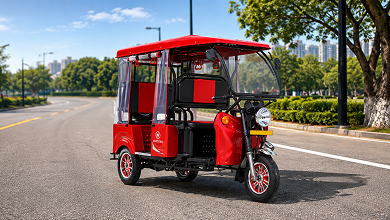
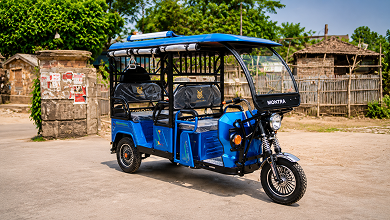

The commercial transport landscape in India is undergoing a fundamental transformation. With rising fuel expenses, evolving municipal regulations, and corporate sustainability targets, business owners, logistics operators, and fleet managers are increasingly exploring EV fleet electrification.
Transitioning a commercial fleet from diesel to electric vehicles (EVs) offers substantial financial and operational advantages. However, electrification is not a simple one-to-one vehicle replacement. It is a strategic business decision that involves evaluating route suitability, financing structures, depot charging infrastructure, driver training, and total cost of ownership (TCO).
This comprehensive guide outlines a structured, evidence-based roadmap for Indian businesses planning to transition from diesel to electric commercial transport.
Operating commercial delivery trucks, last-mile mini-trucks, and corporate passenger fleets on diesel has long been accepted as a standard business expense. Yet, escalating fuel prices and recurring maintenance costs continue to erode operating margins.
Businesses across major commercial hubs—including Mumbai, Bengaluru, Delhi-NCR, Ahmedabad, Pune, and Chennai—are adopting electric commercial vehicles for several key reasons:
Operating Cost Reduction: Electric motors consume significantly less energy per kilometer compared to internal combustion engines burning diesel.
Cost Predictability: Shielding fleet operations from volatile international crude oil price fluctuations.
Tailpipe Emissions Reduction: Complying with corporate ESG (Environmental, Social, and Governance) targets and customer expectations.
Regulatory Compliance: Overcoming municipal daytime entry bans and strict emissions standards in congested urban centers.
Operational Efficiency: Smooth, gearless driving dynamics that reduce driver fatigue during heavy urban traffic.
Successful electrification requires a methodical approach. Businesses must match vehicle capabilities with actual route demands rather than attempting immediate, indiscriminate fleet-wide replacement.
EV fleet electrification refers to the systematic process of replacing fossil-fuel-powered commercial vehicles with battery-electric alternatives. Depending on business size, capital availability, and operational requirements, companies adopt different transition models:
Phased Replacement: Gradually replacing diesel vehicles with electric models as older assets reach the end of their operational lifecycle.
Full Fleet Electrification: Converting 100% of commercial operations to electric vehicles supported by dedicated depot charging infrastructure.
Mixed Fleet Operation: Operating electric vehicles on predictable, high-frequency urban routes while retaining diesel vehicles for long-distance, high-payload intercity corridors.
Leasing & Mobility-as-a-Service (MaaS): Utilizing operational lease models or third-party fleet operators to deploy electric vehicles without incurring heavy upfront capital expenditures.
For most small and medium enterprises (SMEs), a phased transition starting with a pilot program represents the lowest-risk and most financially prudent approach.
Not every commercial vehicle in a fleet is an immediate candidate for electrification. Fleet managers should prioritize replacing vehicles that operate within predictable, high-utilization urban environments.
Daily Distance: Vehicles traveling between 60 km and 150 km per day.
Route Predictability: Fixed urban delivery loops, recurring office commute routes, and scheduled distribution runs.
Payload Requirements: Light commercial payloads ranging from 500 kg to 1,500 kg (ideal for cargo 3-wheelers and electric mini-trucks).
Depot Parking Access: Vehicles with secure overnight parking where slow AC chargers can be installed.
Utilization Frequency: Vehicles operating 25 to 30 days per month.
Last-mile e-commerce parcel distribution and courier loops.
Grocery, FMCG, and dark-store urban deliveries.
Corporate employee transport operating on fixed city routes.
Local wholesale and retail replenishment runs.
Long-distance intercity freight transport exceeding 250 km daily without established highway fast-charging corridors.
Heavy industrial material transport operating on rugged off-road terrain.
Fleets operating in remote rural areas with unstable electrical grids.
Selecting the correct electric commercial vehicle requires matching payload capacity, real-world range, and charging compatibility to your business route.
| Vehicle Category | Typical Application | Key Selection Criteria | Main Consideration |
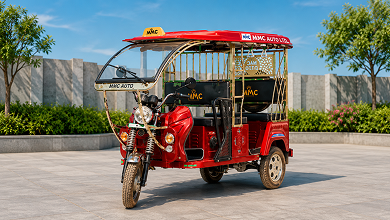
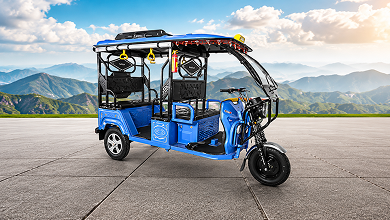
| Electric Cargo 3-Wheelers | Micro-delivery, parcel dispatch, local grocery supply | Payload capacity (500–750 kg), real-world city range | Stability on unpaved roads, battery warranty |
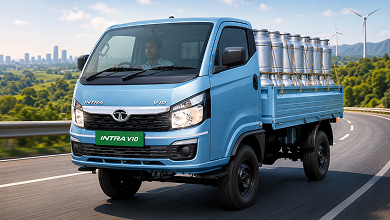
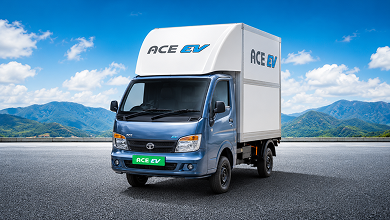
| Electric Mini-Trucks / LCVs | E-commerce logistics, FMCG distribution (600–1,000 kg) | Payload rating, gradeability, real-world AC range | Charging speed, payload volume, driver comfort |
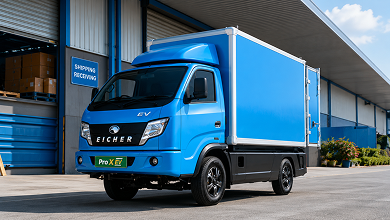
| Electric Delivery Vans | Courier fleets, temperature-controlled pharma delivery | Cargo box volume, payload capacity, fast charging | Fleet management telematics integration |
| Electric Passenger Cars / Vans | Corporate employee transport, executive transit | Seating capacity, AC efficiency, ride comfort | Passenger baggage space, daily shift scheduling |
Note: Always verify current manufacturer specifications, payload limits, and real-world range figures under loaded conditions before finalizing vehicle selection.
Evaluating an electric commercial vehicle based solely on its ex-showroom sticker price is a major financial oversight. Electric vehicles carry higher purchase prices due to battery pack costs, but their operational expenses are substantially lower.
| Cost Component | Electric Commercial Vehicle (INR) | Diesel Commercial Vehicle (INR) |
| Initial On-Road Purchase Cost | INR 988,000 | INR 7,32,000 |
| 5-Year Loan Financing Interest | INR 263,600 | INR 1,78,000 |
| 5-Year Energy / Fuel Costs | INR 2,55,000 (at INR 8.50/kWh) | INR 9,00,000 (at INR 90/L) |
| 5-Year Maintenance & Repairs | INR 60,000 | INR 1,50,000 |
| 5-Year Insurance Premiums | INR 1,60,000 | INR 1,40,000 |
| Depot Charger Setup | INR 25,000 | INR 0 |
| Gross Ownership Expense | INR 17,51,600 | INR 21,00,000 |
| Less: Estimated Year 5 Resale Value | (-) INR 2,30,000 | (-) INR 2,60,000 |
| Net 5-Year TCO | INR 15,21,600 | INR 18,40,000 |
| Net Effective Cost per Kilometer | INR 10.14 / km | INR 12.26 / km |
Takeaway: Despite a higher upfront investment, the electric commercial vehicle saves INR 3,18,400 net over 5 years, achieving full financial break-even within 28 to 32 months of operation.
To measure the financial return on your electrification investment, calculate annual net operating savings and simple payback period:
Annual Net Operating Savings:
Simple Payback Period:
Illustrative Example: If an electric commercial vehicle requires an additional upfront investment of INR 2,56,000 over its diesel counterpart and generates net annual operating savings of INR 1,29,000 in fuel and servicing, the simple payback period is approximately 1.98 years (approx. 24 months).
Reliable charging infrastructure is the operational backbone of an electric fleet. Businesses must establish a clear charging strategy before deploying vehicles.
Depot AC Charging (Slow/Moderate): Installing 3.3 kW or 7.2 kW AC wall-box chargers at your parking yard or warehouse. Ideal for overnight charging (6 to 8 hours) during non-operating hours, ensuring zero daytime downtime.
DC Fast Charging: Utilizing public commercial fast-charging stations along highway corridors or urban hubs for mid-day route extensions.
Workplace & Destination Charging: Equipping corporate hubs with standard grounded 15A sockets for employee or fleet top-ups.
Example: A vehicle travelling 100 km daily consuming 0.20 kWh/km requires approximately 22 kWh of grid electricity per day. Ensure your depot electrical connection has sufficient sanctioned load before installing multiple chargers.
Implementing a successful transition requires a structured, phased approach:
Phase 1 — Fleet Assessment: Log daily mileage, payload weights, route topographies, fuel consumption, and vehicle age across your existing diesel fleet.
Phase 2 — Financial Feasibility: Run TCO models comparing electric models against existing diesel operating expenses.
Phase 3 — Infrastructure Planning: Evaluate depot parking layouts, electrical sanctioned loads, and AC wall-box installation requirements.
Phase 4 — Pilot Program: Procure 2 to 5 electric vehicles to test real-world range, driver adaptation, cargo capacity, and maintenance support.
Phase 5 — Performance Review: Audit pilot operating data against your initial financial projections after 90 days.
Phase 6 — Gradual Scale-Up: Expand the electric fleet incrementally based on verified operational success and charging reliability.
Vehicle technology changes require operational adaptation. Comprehensive training ensures maximum efficiency and vehicle longevity:
Regenerative Braking Training: Teach drivers how to utilize throttle lift-off deceleration to recharge the battery and minimize brake pad wear.
Efficient Driving Habits: Emphasize smooth acceleration and maintaining optimal cruising speeds to preserve real-world range.
Charging Protocol Management: Train staff on safe cable handling, connector locking, and scheduled off-peak depot charging.
Daily Pre-Trip Inspections: Monitor tyre pressures, coolant fluid levels, and battery management system dashboard warnings.
Range Anxiety: Match vehicle battery capacity accurately to daily route lengths and maintain a 20% safety buffer.
Charging Downtime: Schedule all routine slow-charging during overnight parking hours (10 PM to 6 AM) to eliminate operational downtime.
High Upfront Costs: Explore commercial EV financing partnerships, leasing options, and state subsidy schemes to lower initial cash outlays.
Grid Capacity Limitations: Coordinate with local electricity distribution companies (DISCOMs) well in advance to upgrade sanctioned depot loads.
Commercial EV adoption is strongly supported by central and state government frameworks:
PM E-DRIVE Scheme: Central incentive support facilitating the faster adoption of electric commercial vehicles and public charging infrastructure.
State EV Policies: Major states (including Delhi, Maharashtra, Gujarat, Karnataka, Tamil Nadu, and Uttar Pradesh) offer road tax exemptions, registration fee waivers, and capital subsidies for commercial EV buyers.
Permit Exemptions: Battery-operated commercial transport vehicles often enjoy exemptions from commercial permit requirements and municipal entry tolls in urban zones.
Track these key performance indicators (KPIs) to evaluate your electric fleet:
Energy cost per kilometer versus diesel cost per kilometer.
Total operating cost per kilometer (TCO/km).
Vehicle availability and route completion rate.
Unplanned maintenance downtime.
Battery health retention and degradation monitoring.
[ ] Review current diesel fleet mileage and fuel bills.
[ ] Identify high-priority urban routes suitable for EV deployment.
[ ] Calculate 5-year Total Cost of Ownership (TCO) and ROI.
[ ] Inspect depot electrical capacity and parking layout.
[ ] Procure formal vehicle and charging equipment quotations.
[ ] Verify battery warranty terms and local service network availability.
[ ] Launch a small-scale pilot program with 2 to 3 vehicles.
[ ] Train drivers in efficient EV operation and regenerative braking.
[ ] Review pilot operating metrics before scaling up fleet purchases.
EV fleet electrification offers Indian businesses a proven pathway to slash operating expenses, achieve cost predictability, and meet sustainability goals. By conducting careful route assessments, planning depot charging infrastructure, running small pilot programs, and calculating 5-year Total Cost of Ownership, businesses can transition from diesel to electric transport smoothly and profitably.
Explore electric commercial vehicle categories, compare specifications, and review fleet management guides on eVehicals.com.


Manage reminders, payment status, and renewal dates from one simple app.


Trusted by policyholders to track every renewal.