Welcome Back
Please Enter your details to sign in
Forgot Password?
×
Create Your Account
Fill your information below or register with your social account.
Blogs
Home Blogs Detail
Everything You Need to Know About Electric Vehicles – eVehicals Guide

The electric vehicle (EV) revolution is in full stride across the globe, especially in India with the accelerating movement toward sustainable modes of transportation. The electrification of the transportation sector is no longer a niche market but is becoming a mass-market product with advancements in technology, government support, and a surge in the price of fossil fuels.

This comprehensive guide created by eVehicals will provide anyone who is looking to purchase an electric two-wheeler for the first time or is interested in the possibility of purchasing an electric vehicle in India with everything they need to be knowledgeable about the future of electric vehicles.

1. Learn About the Various Types and How EVs Work

"Electric vehicle" refers to a wide range of technologies. Here are the main classifications of electric vehicles and how electric vehicles operate:

EV Type Acronym Power Source Key Feature
Battery Electric Vehicle (BEV) BEV Electricity only Runs entirely on a rechargeable battery; zero tailpipe emissions. (e.g., Tata Nexon EV, Ola S1)
Plug-in Hybrid Electric Vehicle PHEV Electricity + Petrol/Diesel Has both an engine and a large battery charged via a plug. Can run short distances on electricity alone.
Hybrid Electric Vehicle HEV Electricity + Petrol/Diesel Uses the engine and regenerative braking to charge a small battery; cannot be plugged in.

India's electric vehicle market is primarily made up of BEVs in the electric two-wheeler (E2W) and passenger car segments.

2. Electric Vehicle (EV) Benefits

A switch to an electric vehicle comes with a number of individual and environmental benefits.

  • Lower Operating Costs: Electricity is significantly less expensive than gasoline or diesel. Electric vehicles are highly energy efficient, resulting in a much lower cost per kilometer.
  • Lower Maintenance Cost: Electric motors have far fewer moving parts than internal combustion engines; no clutch, no gearbox, no routine oil changes, etc. This means that they have much lower chances of mechanical failure and that they require very little scheduled maintenance.
  • Zero Tailpipe Emissions: BEVs do not produce any exhaust emissions. This helps to improve the air quality in urban areas and contributes to a lower global carbon footprint (when charged with renewable energy).
  • Quiet and Uninterrupted Acceleration: BEVs provide immediate torque for safe and quick acceleration, and they have virtually no noise or vibration.

3. The expansion of the Electric Vehicle (EV) Charging Station Network in India

One of the primary factors contributing to range anxiety, however, is the rapid growth of an extensive charging network.

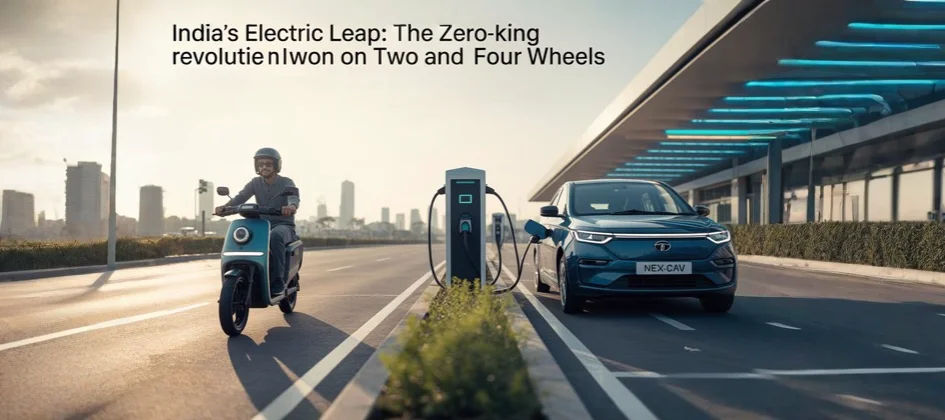
  • Rapid Increase in Public Charging Stations: The increase in public charging stations has increased nearly five times in the past three years to approximately 29,000 in early 2025. Growth has been led by states such as Karnataka, Maharashtra, and Delhi.
  • Government's Desired Outcomes: Through the PM E-DRIVE program and its EV Charging Infrastructure Policy 2025, the Indian government intends to deploy thousands of direct current (DC) fast chargers along highway corridors and within urban centers so that users always have access to charging stations.
  • Most Urban EV Users Charge at Home: Most urban EV users charge overnight while sleeping at home or while at work, therefore not requiring consistent stops to refuel.

4. Overview of Current Electric Vehicle Model Availability Across India (Projected Availability - 2025)

While the electric vehicle (EV) segment has many different types of vehicles across the price spectrum, currently electric two-wheelers (E2Ws) and three-wheelers (E3Ws) are dominating total sales, but rapidly growing passenger cars are being very competitive.

Segment Popular Models & Players Key Feature/Range
Electric Cars (E-Cars) Tata Nexon EV (Leader), Tata Punch EV, MG ZS EV, Mahindra XUV400. Models offer a competitive range (300-450+ km) and performance, often priced in the INR 10-25 lakh bracket.
Electric Two-Wheelers Ola Electric (market leader), TVS iQube, Bajaj Chetak. High growth segment due to affordability and urban convenience; offers ranges typically from 100 to 150 km.

Tata Motors is currently leading in the market of passenger EVs, while other companies are entering the market with new product offerings or upgrades to their existing models, such as Mahindra and MG, allowing customers to be able to have more options when making a decision as to what EV product they would like to purchase and use. Customers can now have access to products that will allow them to have longer range/performance capabilities compared to earlier models, giving them more flexibility when making their purchasing decision.

5. Getting Started: Best EV Charging Tips

Follow these simple best tips for charging your EV:

  • Charge Frequently but Not to 100%: Your battery should be kept in the range of 20%–80% charge for most of your everyday use. Only charge your EV to 100% when you are planning on going on a long-distance journey.
  • Charge at Home: If you can, install a Level 2 AC charger for overnight charging at home, as this is the cheapest way to refuel your EV.
  • Minimize Use of Fast Chargers: Although using a DC fast charger may help you get to your destination quickly during a long drive, overuse of fast chargers will eventually lead to battery deterioration. Only use fast chargers when it is necessary.
  • Use Regenerative Braking: Using your EV's regenerative braking mode (or single pedal driving mode) will allow you to recover some of the energy lost when applying brake force, thus extending your effective driving range for electricity generated through the regenerative braking system. 
Latest Blogs
Ather Rizta vs TVS iQube (2026): Price, Range, Features & Which Family Electric Scooter Should You Buy?
Jun 16, 2026
Ather Rizta vs TVS iQube (2026): Price, Range, Features & Which Family Electric Scooter Should You Buy?
Planning to buy a family electric scooter in India? Check out our detailed 2026 comparison between the Ather Rizta and T…
Read More
Ola S1 X vs Bajaj Chetak (2026): Price, Range, Features & Which Electric Scooter Should You Buy?
Jun 15, 2026
Ola S1 X vs Bajaj Chetak (2026): Price, Range, Features & Which Electric Scooter Should You Buy?
It’s a classic battle between high-tech value and time-tested legacy. This comprehensive 2026 breakdown pits the Ola S…
Read More
Ola S1 Pro vs Ather 450X (2026): Which Electric Scooter Should You Buy?
Jun 13, 2026
Ola S1 Pro vs Ather 450X (2026): Which Electric Scooter Should You Buy?
It’s raw power versus pure precision. This head-to-head 2026 comparison pits the hyper-fast Ola S1 Pro, boasting a 120…
Read More
Subscribe to our
Newsletter
Subscribe to our email newsletter today to receive update
on the latest news