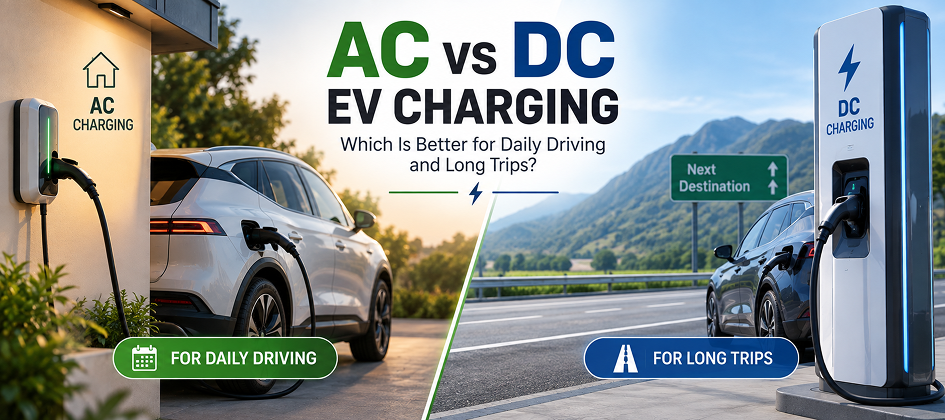
As electric mobility reshapes Indian roads, understanding how to power your electric vehicle (EV) is just as vital as choosing the vehicle itself. Whether you are driving an electric car across national highways or commuting daily on an electric scooter, you will encounter two primary methods for replenishing your battery: AC (alternating current) charging and DC (direct current) charging.
While both supply electrical energy to your battery, they differ fundamentally in charging speed, equipment requirements, per-unit costs, and ideal use cases. This comprehensive guide breaks down AC vs DC EV charging, examining speed curves, real-world Indian electricity costs, battery health considerations, and optimal charging strategies for both daily commutes and long highway road trips.
For most daily driving, AC charging is generally the practical choice, while DC fast charging is more useful when you need to recharge quickly, especially during long-distance travel.
AC Charging: Best suited for regular, overnight, or long-dwell charging at home or the workplace. It provides lower energy tariffs and is gentle on the battery management system.
DC Fast Charging: Essential for rapid top-ups during highway journeys, emergency situations, or high-mileage commercial operations.
The Verdict: Neither method is universally "better"—the optimal choice depends on your vehicle's onboard charging limit, daily mileage, local grid infrastructure, and immediate schedule.
Alternating Current (AC) is the form of electrical power delivered across standard municipal electricity grids and supplied to home wall sockets. However, an EV's traction battery pack operates exclusively on Direct Current (DC).
When you plug your vehicle into an AC charger (whether a standard 15A 3-pin socket or a dedicated 7.4 kW to 22 kW AC wallbox), AC electricity flows through the charging cable into the vehicle. Inside the EV, a physical component called the onboard charger (OBC) converts the grid's AC power into DC power before feeding it into the lithium-ion cells.
AC Power Flow Process:
Power Grid (AC) → AC Charger Cable → EV Onboard Charger (Converts AC to DC) → EV Battery (DC)
Converts Inside the Vehicle: The conversion from AC to DC happens internally via the vehicle's onboard charger.
Home & Workplace Centric: Ideal for locations where a vehicle remains parked for several hours (e.g., overnight at home or during working hours at the office).
Power Levels: Typical home portable chargers supply 3.3 kW (Level 1), while dedicated AC wallboxes supply 7.2 kW to 22 kW (Level 2).
Convenience: Allows drivers to wake up or leave work every day with a fully charged battery without making dedicated trips to commercial stations.
Direct Current (DC) fast charging bypasses the vehicle’s internal onboard charger entirely. In a DC fast charging station, the massive AC-to-DC power converter is housed inside the off-board public charger cabinet rather than inside your car.
Because the off-board station is connected directly to high-voltage industrial grid connections, it can supply DC power directly to the EV's battery pack at significantly higher power levels.
DC Power Flow Process:
Power Grid (AC) → Public DC Station Converter (Converts AC to DC) → Direct DC Power Cable → EV Battery (DC)
Bypasses Onboard Converter: Delivers converted DC power directly to the battery terminals, eliminating the size and weight restrictions of an internal vehicle converter.
High Output Power: Public highway DC fast chargers in India typically output anywhere from 30 kW, 60 kW, and 120 kW up to 240+ kW.
Highway & Commercial Transit: Designed for quick 20- to 50-minute stops during long trips or rapid fleet turnaround.
Dynamic Speed Variability: Charging speed is heavily regulated by the vehicle's Battery Management System (BMS) to protect cell health based on temperature and state of charge (SoC).
| Factor | AC Charging | DC Fast Charging |
|---|---|---|
| Typical Use | Daily home/workplace routine charging | Long-distance trips, highway stops, quick top-ups |
| AC-to-DC Conversion Location | Inside the EV (via Onboard Charger) | Inside the Public Charger Cabinet (Off-board) |
| Typical Charging Speed | Generally slower (3.3 kW to 22 kW) | Generally faster (30 kW to 240+ kW) |
| Common Location | Homes, apartment complexes, office parks, hotels | Highway rest stops, public charging hubs, commercial hubs |
| Equipment & Installation | Lower cost; uses single/three-phase AC grid lines | High infrastructure cost; requires dedicated high-voltage grid lines |
| Cost Per kWh (India) | Lower (domestic tariffs / EV home rates) | Higher (includes operator service charges & GST) |
| Best For | Overnight dwell times & low battery stress | Minimising travel downtime on long journeys |
A common misconception among new EV buyers is that plugging a vehicle into a 150 kW DC fast charger guarantees the car will charge at 150 kW. An EV charger only offers power; the vehicle’s Battery Management System (BMS) dictates how much power it accepts.
Onboard Charger (OBC) Limits (AC): If your electric car has a 7.2 kW onboard charger, plugging it into a 22 kW AC station will still result in a maximum charge rate of 7.2 kW.
Vehicle DC Acceptance Cap: Every EV model has a maximum DC input rating set by the manufacturer. For example, an entry-level city EV might cap DC charging at 30 kW, while a premium EV SUV might accept up to 150 kW.
The DC Charging Curve: DC charging speeds are non-linear. To protect the battery from overheating and degradation, the BMS requests maximum speed between 10% and 80% State of Charge (SoC). Beyond 80%, the BMS dramatically throttles power down to a trickle rate.
Battery Temperature: Cold batteries or thermally stressed (overheated) batteries prompt the BMS to slow incoming current to prevent cell damage.
To learn more about how thermal management impacts long-term battery performance, read our guide on EV battery degradation in India.
Electricity tariffs and public charging pricing in India vary significantly across states, charge point operators (CPOs), and power ratings.
Home AC Charging: INR 4.50 to INR 10 per unit (kWh) depending on state domestic slabs or dedicated EV connection tariffs.
Public AC Destination Charging: INR 8 to INR 15 per unit (kWh) (includes CPO service fees and 5% GST).
Public DC Fast Charging: INR 15 to INR 25 per unit (kWh) (reflects high commercial demand charges, station capital expenditures, and 5% GST).
(Assumptions: Electric car with a 40 kWh battery pack, driven 1,000 km per month, achieving a real-world efficiency of 8 km per kWh, requiring 125 kWh/month).
Home AC Charging (@ INR 8 / kWh): 125 kWh x INR 8 = INR 1,000 / month (~INR 0.80 per km)
Public DC Fast Charging (@ INR 20 / kWh): 125 kWh x INR 20 = INR 2,500 / month (~INR 2.00 per km)
Estimated Monthly Savings using Home AC: ~INR 1,500 per month
(Note: The above calculation is illustrative. Real-world costs vary based on charging efficiency losses [approx. 10–15%], local DISCOM tariffs, and specific operator session fees.
For a full breakdown of per-kilometre operating costs across scooters, bikes, and cars, view our detailed guide on Electric Vehicle Cost Per Kilometre in India.
For day-to-day commuting, AC charging is generally the superior and most practical method.
Maximum Cost Efficiency: Charging at home overnight utilises lower residential electricity slabs.
Time Savings: Plugging in at night takes less than 30 seconds of active effort. You start every morning with a full battery, eliminating trips to charging hubs.
Lower Thermal Stress: Lower power transfer keeps battery internal temperatures low, minimising degradation over multi-year ownership.
When Daily DC Makes Sense: If you drive for a ride-hailing fleet, cover 200+ km daily, or live in an apartment complex without home socket access, occasional public DC fast charging provides necessary operational top-ups.
For interstate highway driving and long journeys, DC fast charging is essential.
Minimises Downtime: A 30 kW or 60 kW DC charger can replenish a 40 kWh battery from 10% to 80% in roughly 40 to 50 minutes—perfectly timed for a highway lunch or tea break.
Corridor Availability: Indian motorways and national highways increasingly feature DC fast-charging hubs spaced every 50 to 100 km.
Plan Around the 10% to 80% Window: Do not waste time charging from 80% to 100% at a DC station; the throttled trickle-charge speed makes it inefficient. Unplug at 80% and resume driving.
Pre-Check Station Reliability: Use aggregator apps to verify charger uptime, plug status, and nearby amenities before navigating to a station.
Identify Backup Stations: Always leave a 15–20% battery buffer to reach an alternate nearby charger if your primary target station is occupied or offline.
A frequent concern among prospective buyers is whether fast charging damages lithium-ion cells. DC fast charging does not automatically ruin an EV battery, but frequent high-power charging generates heat and mechanical stress that can accelerate cell ageing over time.
When high current flows rapidly into a lithium cell, it increases internal resistance and temperature. If heat is not managed effectively, it can cause lithium plating on the anode, reducing the total usable capacity of the pack over several years.
Active Liquid Cooling: Most modern Indian electric cars employ active liquid cooling systems that circulate coolant around cells during DC charging to pull heat away.
Smart BMS Control: The BMS continuously measures individual cell voltages and temperatures, slowing power delivery if thermal thresholds are crossed.
The Practical Guideline: Relying on DC fast charging for occasional highway trips or emergency top-ups causes minimal long-term degradation. However, using high-power DC chargers as your sole daily charging method may lead to slightly faster capacity loss compared to gentle AC home charging.
Read our detailed breakdown on EV Battery Warranty Explained to understand manufacturer health-retention terms.
Battery longevity is determined by a combination of charging habits, climate, and cell chemistry.
LFP vs NMC Chemistry: Many popular electric cars and two-wheelers in India use Lithium Iron Phosphate (LFP) cells, which are thermally stable and tolerate frequent fast charging better than traditional Nickel Manganese Cobalt (NMC) chemistries.
Temperature Management: Charging in extreme Indian summer heat (40°C+) creates extra thermal load. Parking in shaded areas or charging during cooler overnight hours helps preserve pack health.
Depth of Discharge: Keeping the battery operating between 20% and 80% during routine daily commuting places less strain on internal cell structures.
Compare cell characteristics in our companion guide on LFP vs NMC EV Batteries.
The ideal charging upper limit depends directly on your vehicle's chemistry and your immediate driving plans:
Daily AC Home Charging (NMC Batteries): Manufacturers typically recommend setting your daily AC charge limit to 80% or 90% to minimise degradation. Charge to 100% only when preparing for a long highway journey.
Daily AC Home Charging (LFP Batteries): LFP packs tolerate 100% charges much better. In fact, many manufacturers recommend charging LFP-equipped EVs to 100% at least once a week via AC charging to help the BMS recalibrate individual cell balance.
Public DC Fast Charging (All Chemistries): It is generally best practice to stop DC fast charging at 80%. Beyond 80%, charging slows down considerably, increasing your session cost and blocking the charger for other users.
| Situation | Recommended Charging Approach | Rationale |
|---|---|---|
| Daily Urban Commute | AC Home / Office Charging | Lowest cost per kWh, convenient, zero battery stress. |
| Overnight Home Parking | 3.3 kW or 7.2 kW AC Wallbox | Full battery by morning using standard residential rates. |
| Long Highway Trip | DC Fast Charger (30 kW–120+ kW) | Minimises travel downtime; charges from 10% to 80% during breaks. |
| Workplace Parking (8+ Hours) | AC Level 2 Charger | Replenishes daily commute distance while the vehicle sits idle. |
| Emergency Low Battery in City | Nearest Available DC Fast Charger | Adds 30–50 km of quick emergency range in 10–15 minutes. |
| Multi-Day Vacation / Hotel Stay | Hotel Destination AC Charger | Slow charges safely overnight without needing dedicated fast-charging runs. |
Different electric vehicle segments in India have vastly different charging requirements and capabilities:
Electric Cars: Dual AC (3.3–11 kW) + DC Fast Charging (30–150 kW) support is standard across most passenger vehicles.
Electric Motorcycles: AC charging is universal, with DC fast-charging supported on select performance models.
Electric Scooters: AC home charging is universal, while DC fast-charging support varies by brand and network.
Commercial Fleets: High-power DC fast charging is heavily utilised to ensure maximum operational uptime.
If you are setting up charging infrastructure at home or evaluating a new vehicle purchase, follow this step-by-step decision framework:
Verify Your Vehicle's AC Onboard Limit: Check whether your car accepts 3.3 kW, 7.2 kW, or 11 kW AC power to avoid over-specifying your home charger purchase.
Evaluate Home Electrical Load: Check if your residential electricity meter has sufficient sanctioned load (e.g., 7 kW single-phase or three-phase) to support an AC wallbox without tripping main breakers.
Assess Daily Driving Distance: If you travel less than 40 km per day, a standard 3.3 kW (15A socket) portable AC charger will easily replenish your battery overnight.
Inspect Apartment / Parking Access: Ensure you have a designated parking spot with permission from your housing society (RWA) to route cabling for an AC charger.
Map Highway Route Infrastructure: If you travel frequently between cities, use CPO apps to verify the density of DC fast chargers along your primary routes.
| Factor | Home AC Charger | Public DC Charger |
|---|---|---|
| Convenience | High for routine daily use; wake up every morning fully charged. | High during mid-trip travel; requires visiting a station. |
| Charging Speed | Slower (typically 3 to 8 hours for a full charge). | Faster (typically 20 to 50 minutes for 10%–80%). |
| Per-Unit Cost | Lowest (standard residential tariffs: INR 4.50–INR 10/kWh). | Higher (commercial rates + service fees: INR 15–INR 25/kWh). |
| Availability | Exclusive to you or your residential building. | Subject to queueing, station maintenance, or public access. |
| Battery Impact | Gentle; minimal heat buildup. | Moderate thermal load; managed actively by vehicle BMS. |
Economical: Lowest cost per kilometre when using residential grid tariffs.
Convenient Routine: Charges seamlessly while you sleep or work without interrupting your day.
Battery Friendly: Low power flow generates minimal heat, preserving long-term battery health.
Accessible Equipment: Portable chargers plug into standard 15A electrical sockets.
Slow Speed: Unsuitable when you need rapid energy replenishment on short notice.
Requires Dedicated Parking: Less convenient for owners without assigned home or workplace parking spaces.
Rapid Turnaround: Adds substantial driving range in under 45 minutes.
Enables Long-Distance Travel: Makes highway road trips feasible across major corridors.
Emergency Safety Net: Quickly resolves unexpected low-battery situations in urban areas.
Higher Operating Cost: Rates can be 2x to 3x higher per unit compared to home charging.
Network Dependence: Station availability depends on CPO maintenance, grid stability, and queues.
Higher Heat Load: Frequent, exclusive use can place greater thermal demands on the battery pack.
When evaluating AC vs DC EV charging, the answer is not about choosing one over the other—it is about using each method where it excels:
Use AC charging for 80–90% of your daily needs: Plug in overnight at home or during the day at work to keep your operational costs low and preserve long-term battery health.
Use DC fast charging for highway journeys and quick top-ups: Rely on public fast-charging stations when travelling long distances or when unexpected daily mileage requires a rapid battery refresh.
By establishing a balanced charging routine that combines convenient AC home charging with strategic DC highway stops, you can maximise your electric vehicle's savings, performance, and battery lifespan.

Manage reminders, payment status, and renewal dates from one simple app.


Trusted by policyholders to track every renewal.